
The use of gold, when combined with good design, gives to certain kinds of printing a distinction and quality unobtainable by any other means.
Update: August 2017 — Typoretum’s tweet, below, shows the big difference between using gold ink and bronzing powder.
https://twitter.com/typoretum/status/785475011071148033
Gold printing is used in the production of high-class labels, wrappers, box tops, covers, greeting cards and other work where bright, showy effects are appropriate. Gold and other metallic colours are produced by the letterpress process in three different ways –
-
Metallic Ink: printing direct, using gold ink made from bronze powder, or silver ink made from aluminium powder or paste.
-
Bronzing: printing first with a tacky preparation and immediately dusting with bronze, aluminium or other metallic powder which adheres to the tacky preparation.
-
Foil Printing: metal foils are pressed on the paper or other stock after the manner of blocking. The foils are usually supplied with an adhesive dressing which is made active by heat, so that heat as well as pressure is required to attach it to the paper or stock. Foils other than metal are available and the process is limited to platen and blocking presses
Gold Ink
The difficulties associated with printing gold ink by the letterpress process and the relatively poor results obtained on any other than coated or glazed stocks must be admitted. The ink is made from very fine bronze powder suspended in a special oil varnish vehicle, and it is not a homogeneous compound. Some ink firms supply the powder and vehicle separately for mixing in small quantities fresh at the machine, with improved results. On cover paper, bonds and other rough-finish papers, it is advisable to use a neutral size base for the first impression and print the gold on the base. This helps to lift the gold ink from the plates. A second working in the gold ink is also practised and gives a brighter effect, but this is likely to be marred by feathered edges around the designs.
For best results, the rollers of the press must be in perfect condition and set as only an expert can set them, with exact contact throughout. The impression must be light and level; excessive pressure moves the soft ink to the edges of the design. Making-ready should be accomplished with some thin, light-coloured ink, and the gold ink mixed and run up fresh when the job is perfectly ready for the run. In mixing the gold ink it should be kept thin so that it runs off the palette knife-never short and buttery-and only a small quantity should be mixed at a time. When making two workings in the gold to get a brighter effect, the ink on the first working should be kept sparse and the effect obtained on the second working. Register must, of course, be perfect. The machine must be washed up whenever the quick drying ink begins to thicken on the rollers, or when the quality of the work deteriorates, which is usually after a run of about two hours. It must also be washed up at the mid-day break.
The above remarks apply also to silver ink, although this is not quite so difficult to work and the results obtained are better. The ink, supplied ready mixed, is made from aluminium powder, and comparatively recent developments in the methods of manufacture have greatly improved the product.
Frequently an additional working in gold or silver is required in four-colour process work, and generally speaking, with these light formes and good quality coated papers, metallic inks are ideal for this purpose and have proved a great boon.
Bronzing

By far the greater bulk of letterpress work in gold is produced by bronzing, and the results obtained by this method are excellent. The process involves, first, printing the sheet in a tacky medium such as bronze preparation and then dusting it with bronze powder which adheres to the preparation. It is then lightly burnished to smooth and brighten the bronze and the loose bronze is cleaned off the sheet. Small work can be bronzed by hand, but the work must be carried out under vacuum. Bronzing machines have been available for a period of years.
Home Office Regulations. All bronzing work is regulated by Home Office Regulations, a copy of which may be obtained from H.M. Stationery Office.
The Bronze Preparation. A brown pigment containing copal varnish and gold size is used as preparation, and is supplied in different grades by all ink manufacturers. When the design is printed and bronzed the preparation should dry hard on the surface of the paper by oxidation, and so hold and seal the bronze which is dusted on.
The difficulties associated with the preparation are: plucking; failure to hold the bronze (which may remain moderately loose on the paper and come off in handling); drying on the machine.
Plucking. The nature of the preparation to hold and seal the bronze on the paper must be strong and tacky. Nothing of a penetrating nature such as raw linseed oil or greasy solid solvents should be added if it can be avoided. The best results are obtained by working it as stiff as possible, so that it is on the verge of plucking all the time. Two grades of preparation should also be stocked, one stronger than the other, so that either may be used alone or blended to suit the requirements of the particular paper. Boiled linseed oil (which does not penetrate) may be used sparingly as a reducer. The speed of the press should be regulated to suit the paper, and production must be continuous because the slightest delay allows the preparation to begin setting on the machine and plucking is inevitable.
Bronze not Holding. This is one of the major problems encountered in bronze work. If the bronze rubs off, the appearance of the work is marred, and with food containers (chocolate wrappers, etc.) the slightest trace of loose bronze cannot be tolerated. To prevent this the work is often overprinted with a very thin film of varnish to seal the bronze.
The difficulty arises chiefly in connection with absorbent papers which allow the preparation to penetrate so that insufficient remains on the surface to hold the bronze.
The preparation should have the right characteristics so that it is largely a question of the quantity carried, which should allow for the penetration that takes place and yet leave sufficient on the surface of the paper to hold the bronze.
This is not easy, as designs will often include extremes of solid and fine detail and the solid areas will require so much preparation that the fine detail will fill in.
The work often takes the form of large sheets printed from electrotypes mounted on one large mount. Much can be done in the method and manner of the making-ready. The plates will need interlaying so that the solid parts are well up to type height, but the fine detail (as, for instance, long imprints in five-point lining sans) is kept slightly below type height. The work on top (cylinder) must also be carefully carried out, and all fine detail must finish quite level but light. In this way it will be found that much more preparation can be carried (without filling-in) to hold and seal the bronze.
When the actual bronzing is taking place some distance away from the printing press, the sheets have to be carried in batches and there is the risk of the preparation partly drying before the sheets are bronzed, the holding power of the preparation being largely lost. Notice should always be taken of the last sheet bronzed in each batch. This should be dusted clean occasionally to ensure that the preparation is not too dry to take the bronze. The number of sheets carried in each batch can then be arranged accordingly.
Drying on the Machine. Owing to its quick-drying nature the preparation should not be runup on the machine until the job is ready to run, making-ready being accomplished with a non-drying ink. During the run, the machine should not be allowed to stand, as even a stiort delay will allow the preparation to set. The machine will require washing up at mid-day as well as at the end of the day’s run. As far as possible no non-drying solvents should be used in bronze preparation.
The Bronze Powder. Gold bronze powder is made from copper, brass and zinc alloy. The molten metal is reduced in the process of manufacture to minute leaf particles and sifted through fine silk. It is then graded in degrees of fineness by gravity, greased and polished, but its flake-like form is retained. In addition to the standard tones (pale, rich pale, and rich), deeper gold tones are produced by the application of heat. There are also copper-coloured bronzes (made from copper), silver (made from aluminium), and other colours such as green, blue and fire-red, which are obtained by the use of dyes.
The finest texture powders have the best covering power, but are inclined to “pick up” on previous workings on the sheet and also stick to the paper-resisting dusting-if the paper is at all rough, as cover paper, etc..The coarser bronzes will, therefore, be found more suitable for such conditions. If coarse bronze “picks up” on previous workings on the sheet, the fault lies with the previous workings which have not dried correctly. Great care in the choice and treatment of the ink is necessary when there is to be a subsequent working in bronze. However, the trouble can be cured or minimized by adulterating the bronze with magnesia powder, but in extreme cases the work will have to be treated with magnesia alone before the bronzing operation.
Hand Bronzing. Hand bronzing is used only for small sheets and comparatively short runs on platen presses. The work must be carried out under vacuum, and it is uneconomical to handle sheets larger than crown by the hand process. Up to this size, with proper arrangements, nothing excels the hand process for quality.
A useful piece of equipment is the Vacuum Hand Bronzer (Mark Smith patent), which comprises a hand bronzing table of box-like construction and a sloping glass front through which the worker can watch his work. At the back is a vacuum box with a suction fan driven by a small built-in motor which also drives a dusting-off device. For dusting-off purposes the sheets are pushed one at a time between two rollers through a long slot in the vacuum box and withdrawn against the action of the rollers which revolve inwards together and clean both sides of the sheet. The loose bronze is sucked away by the fan which also draws away all loose bronze during the process of hand bronzing. (See Fig. 1.)
A large pad of cotton wool, enough to fill the hand is used for the bronzing. The bronze is first lightly dusted on, care being taken to avoid smearing the preparation, and then rubbed harder to burnish.; On rough-surfaced papers the bronze must not be rubbed so hard that it becomes ingrained into the, paper around the design; if this occurs, it will be very difficult (if not impossible) to dust off. The preparation gradually impregnates the surface of the cotton wool, which should be changed frequently by pulling the wool apart; and turning it about, otherwise the pad will mark the work.
The sheets should be carried to the hand bronzer in small quantities that can be dealt with before the preparation becomes too dry to pick up the bronze properly. Constant attention must be given to this.
When the bronzed work is dry, it can be cleaned of all loose bronze in the dusting rolls or otherwise with cotton wool by hand under vacuum.
Machine Bronzing. When large quantities of bronze work are handled the work will be printed in large sheets on cylinder presses and run through bronzing machines. The sheets can be carried from the one machine to the other in dozens supported on a card, placed on the flat feed-board of the bronzing machine, and hand fed. The speed of the two machines should be regulated so that there is no delay.
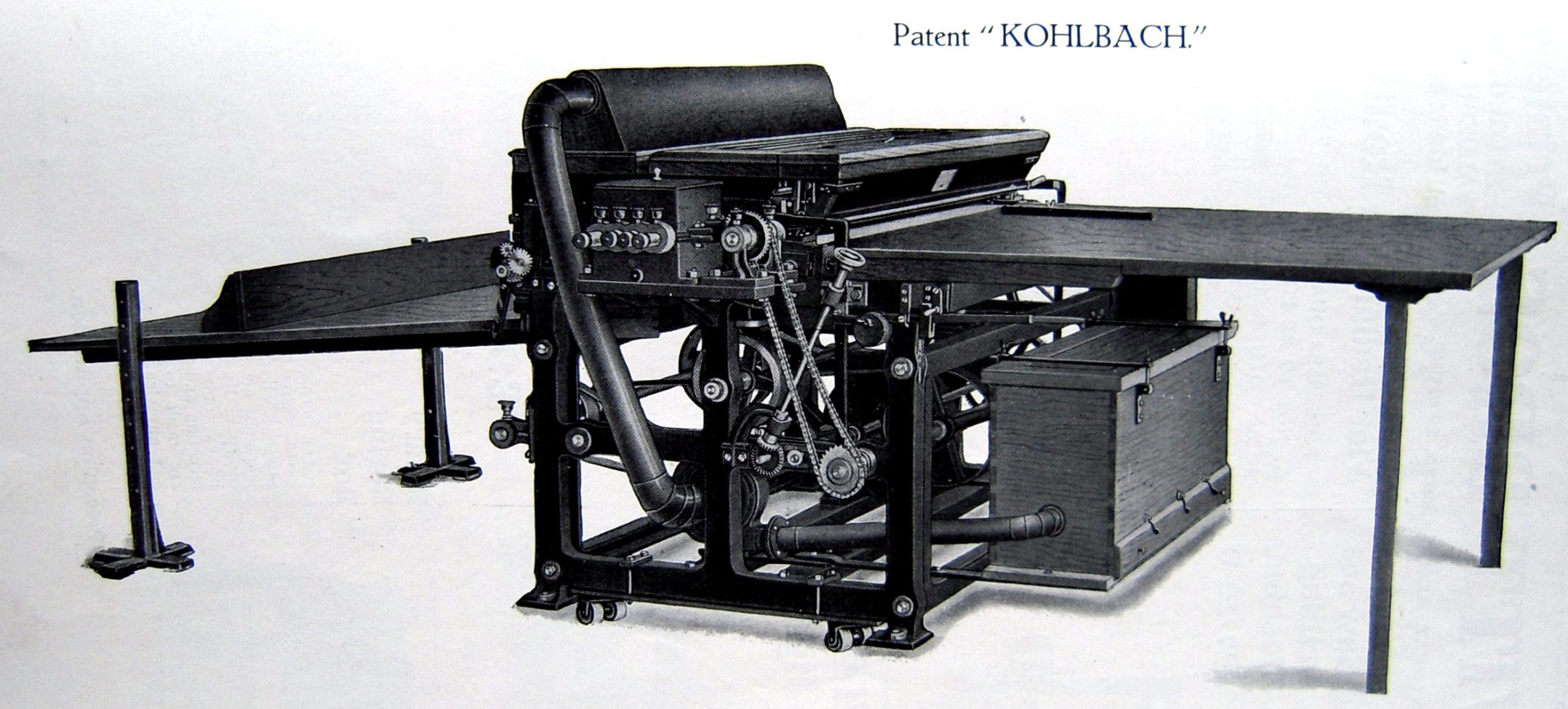
Two main types of bronzing machine are available* the cylinder type and the more modern endless flat belt type.
Mark Smith Vacuum Bronzing Machine, There is still a good deal to be said in favour of the old cylindrical style of bronzing machine which gives long and reliable service. A large drum cylinder with tumbler grippers and a flap (which closes the gap in the cylinder and so protects the leading edge of the sheet) takes the sheet from the front lays, which swing away. As the sheet moves forward, it passes under the duct in which a plush-covered roller revolves and flicks the bronze on to the sheet. Duct leads confine the bronze laterally to the limits of the design, and the turn of the duct roller is adjusted for length by a ratchet and pawl arrangement to confine the bronze to the depth of the design. Ranged around the cylinder are the various dusting on, burnishing, and dusting off rollers and devices (thirteen in all) covered with plush and monkey skin. The two burnishing rollers are of different diameters and revolve at different speeds, and also have a lateral reciprocating motion. The last two dusting-off rollers make contact with the delivery drum and so clean the back of the sheet. The bearings of all rollers are held in slots for instantaneous adjustment: of contact.
The whole machine is efficiently boxed in, and there should be a window for general inspection purposes. Surplus bronze drops to the bottom of the machine where it is drawn up by means of a suction fan and conveyed by a wide pipe back into the duct. The action of the fan exhausts the air inside the machine and creates a partial vacuum so that air is continually drawn into the machine from the room and takes any loose bronze with it. Over the duct the bronze drops down by gravity, and the conducting air escapes upwards along a pipe into the outside atmosphere. The machine is simple to adjust and work, and every part is readily accessible.
Flat-bed Bronzing Machines. The latest type of bronzing machine is the flat-bed style. The sheets are led into the machines by an adjustable roller and are carried through on an endless rubber blanket; there are neither lays nor grippers.
In some of the machines the bronze is dusted on by oscillating pads (“Milwaukee,” “Furnival” and “Omega”) and in others by endless plush bands working across the machines (“Laco”). Pads are also employed to burnish and smooth the bronze on the design. There are lateral dusting-off bands to remove the surplus bronze; these make contact with brushes and in this way keep clean themselves. The final dusting off is done by rollers which clean the sheet just before delivery. All the rollers, pads and bands are adjustable.
The machines are fully enclosed and are fitted with exhaust fans and air ducts. The strong internal vacuum draws all surplus bronze away, and it is automatically filtered and gathered to be used over again when freshened up with new bronze.
This type of machine is often described as “portable” because it is mounted on castors and can be moved about the machine-room from one press to another. It is, however, heavy and difficult to move among the other machines.
As all the operations of bronzing, burnishing and dusting are done on the flat, these machines are of greater length than bronzing. machines of the cylinder type and take up considerably more floor space.
Coupling the Bronzing Machine to the Printing Press. Sometimes the bronzing machine is coupled up to the printing press so that the sheets run direct from one machine to the other. Where the amount of bronze work warrants this, it is an excellent arrangement. Apart from the saving in time, which is considerable, there is no delay between the printing and bronzing and the printed sheets are bronzed in the correct sequence, with maximum efficiency. Both styles of bronzing machine lend themselves readily to the coupling system, the cylindrical style being coupled on and driven by the printing press through a connecting shaft and movable clutch. This necessitates a carriage containing travelling tapes driven from the bronzing machine end (which can be supplied or made to specification).
The two-revolution press delivery is suitable for this principle, the sheets passing from the tapes of the press to the tapes of the connecting carriage and so to the bronzing machine, where a sloping tape feed is sufficient without other attachment. When not in use the carriage is pushed up out of the way and held by counter weight. This arrangement allows the printing press to run on other than bronze work when required, and in the meantime the bronzing machine may be used for dusting, etc.
In flat bronzing machines, the coupling arrangements are simpler and, as they have no grippers or lays, the need for exact timing is not so necessary. The machines can be driven independently and the speeds synchronized.
Foil Printing
The use of foils in rolls has been developed in connection with bookbinding for blocking the titles and designs on the fronts and spines of covers for books, etc. These foils are usually made on rolls 200 ft. in length, on a backing of glassine paper, and can be supplied in any width. They are prepared with an adhesive surface ready for blocking on almost any material, and the heat and pressure used in the press at the time of blocking fixes the foil to the material. Foils are manufactured in genuine gold (22 and 18 ct.), imitation gold, silver, a‑large range of metallic and flat colours and white. (V. Goulding and Co.
Ltd.)
The Machines. Various machines are available for using foil, ranging from small hand machines to large power blockers, incorporating roll feed attachments for the foil, and giving impressions up to 25 per minute. Brass dies, brass type, or special electrotypes and stereotypes are fixed to the upper platen (or bed) of the press, which is heated to 200F., and guides are fixed to the lower platen (or drawer) so that the covers are set to a central position in line with the dies. Between the two platens is the foil, which runs off the roll in front of the machine and between two rollers at the rear so that a continuous strip of roll leaf runs across the face of the die. Under pressure the heat fuses the adhesive so that the design in foil adheres to the stock and is pulled away from the backing paper. The scrap foil remains on the backing and is rewound at the back of the machine. At the same time a new surface of foil is pulled over the die ready for the next impression. The roll feed attachment will draw any length of foil up to the full capacity of the heater plate. Other types permit the drawing of two or more different widths and lengths; this makes it possible to cover different sizes of impression on the same die or dies, with minimum waste of foil. Different coloured foils can be used simultaneously.
The advantages of foil printing for various otherwise difficult surfaces and materials (as compared with the lifting and drying of ordinary printing inks) are now realized, and the process and machines are used for printing on celluloid labels, radio panels and parts; metal and plastic nameplates, dials and scientific instruments, etc During the war, foil printing was used widely for the speedy production of instruction labels, nameplates, etc., for aircraft, tanks and ships, each of which requires numbers of labels, either in metal, plastic or transfer; of these, millions were printed.
Foil Printing on Platen Presses. Roll feed attachments and heating plates are also successfully fitted to platen presses of both the direct approach and clam-shell types, the attachment conforming to the style of the particular press, e.g. “Peerless” roll feed attachment (see Fig. 2) is readily fitted to the heavy-duty “Craftsman” or the “Victoria” presses. The heater plate is also supplied complete with rheostat control, regulation switch and clips for holding the plates; the fitting of these attachments to equip the machines for foil printing in no way interferes with the inking mechanism of the press for ordinary work.
Foil Printing and Embossing. When platen presses are fitted with roll leaf feed attachments for foil printing, the principle also lends itself to the application of foils and embossing in one operation for the production of high-class covers, showcards, greeting cards, box tops, etc. The work is very effective and distinctive on any kind of stock. With dark cover stocks the opaque flat coloured foils are often an improvement on ordinary printing inks. The embossing die is made ready in the usual way and forces made, and the continuous strips of foil are run over the heated die so that the stock, foil and backing are all, embossed together, the foil being released from the backing to adhere to the stock. A feature of the work is the’ perfect register as the foil printing and embossing are accomplished in the same operation.
Historical article from the British Printer