
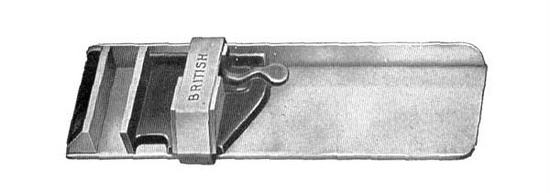

Printing works of all sizes hold an unhealthy fascination for me. Since seeing my first commercial book printers at the Incline Press, and then works ranging from the small (like St. Margaret’s Press) to the largest (Hand & Eye Letterpress), I have been keen to document what is needed to make a printing works.
In trying to help new printers, I want to be able to say ‘here is what you will need’, and ‘here is what to look out for’.
I have used a number of sources and tried to balance this list with my personal experience. Here you will find my list of everything you will need — aside from type and press. I have also divided the list in to a ‘starter’ section and an ‘advanced’ section — although you should be able to produce top-quality work from the ‘starter’ section, where space and money permit you can profitably move through to the ‘advanced’ section.
I would truly appreciate any comments you might have on this list.
Compositor’s Tools
| Starter | Advanced |
| Type Scale: metal if possible, then plastic, then wood | Setting rules: graduated, precision-cut brass rules to set the composing stick to a determined length |
| Tweezers and Bodkin (although the use of each of these is discouraged) | Make-up galley: a special galley with one side that can be set to the line length. As lines are moved from the stick, they can be set in this galley to be sure that lock-up will be an easier activity |
| Composing Sticks (ideally 8″ and 12″) |
Spacing
| Starter | Advanced |
| Furniture: wood, lead or steel, but see ‘advanced’ for better options. Standard sizes are 24, 36 (or Narrow), 48 (or Broad), 60, 72 (or Double Narrow) and 96 pica (or Double Broad) | More precise furniture: made of aluminium or plastic (Formica) |
| Leads: typically in 1, 1½, 2, 3 or 4pt. In starting out you might want to standardise on length (usually multiples of 5 or 6 pica) and width (usually 1½ and 2pt) | Interlocking Furniture: this consists of iron bars with mitred ends that can be assembled together to form large ‘frames’ of space bordered by metal bars |
| Reglet or Clumps: usually 6 or 12pt wide. Reglet is the term for wood (usually oil-soaked) and clumps for metal | |
| Quotations or Quads: essential to fill small area of white space |
Imposition
| Starter | Advanced |
| Quoins: ideally Notting but possibly Wickersham, Hempel or — as a last resort — wood | Prescision quoins: torque quoins (that exert a given force), or register quoins (that have markings to show the exact amount of force) |
| Lead and rule cutter: with micrometer adjustment if possible | Mitreing machine: either rotary (a ‘bowler’), vertical, or powered Slug cutter Powered saw |
| Machine chases (those that come with your press) | Specialist chases: book, folding, jobbing |
| Page cord to tie up blocks of lines, ideally using furniture with channels to acommodate the cord | “Quick‑S Lockup” interlocking metal corners with sprung edges |
| Imposing surface: starting with a granite chopping board or thick glass; to steel surfaces | Type-high gauge |
| Mounting surfaces for blocks |
Furniture (for the works, not for the forme)
| Starter | Advanced |
| Small type cabinet and cases: usually Adana cases in various sizes | Full-size printers typecases and cabinet, specialist cases for blocks, script, woodletter, rule etc. |
| Lead storage: can be a box divided in to standard lengths | Lead and furniture racks |
| Galleys to store standing jobs | Random top on which to put type cases while setting type |
| Space bins |