
From Print Week: the Adana 8 x 5 has returned to production!
Tag: Adana
-

The Adana 5 x 3
It was April 1956 when the Adana 5 x 3 was unveiled. The machine replaced the H/S1 (High Speed 1) machine with it’s tiny 3″ x 2″ chase. This new machine was supplied with a small interior chase of 2¼” x 4¼” which allowed more adventurous work to be undertaken than on the H/S1.
In terms of materials, it was one of the earliest Adana machines to be made of an aluminium alloy, rather than cast iron.
Production of the machine ended in the mid-1980s.
-

Adana T/P48 and Adana P71
Adana had a history of producing machines powered by treadle (and not hand) before the T/P48 appeared. A patent held by the founder of Adana (Donald Aspinall) and an engineer demonstrates the principle from the 1920s; and the firm made an Adana Treadle Platen around 1926. This family of machines has an unusual approach of a D‑shaped drum to act as inking cylinder with the flat area holding the chase. Inking rollers revolve around the drum and on to the forme — this whole assembly moves to impress on a static back platen holding the paper.
Other construction details led to a loyal following of users: the stand was made from tubular steel, the main frame from a light alloy. This kept the weight to around 2¾ cwt. Cast iron was used where needed for strength: the platen and side arms.
In use, the unusual operating principle has some positive side effects — the feed is to a static bed (as only the platen moves) so is easier to use than a moving back platen; the inking is adjustable and uses more rollers than other Adana machines; and the machine is chain-driven so there is less fatigue on the operator.
The T/P48 was launched as the T/P47 at the British Industries Fair in 1947 but restrictions on UK manufacturers meant the machine was not advertised in the UK until August 1949. Incidentally the T/P stands for Treadle/Power as the machine could be powered by foot or electricity. This serves to highlight the apparent arbitrary nature of Adana’s naming system!
In 1971 the machine was updated as the P71– but this appeared to be cosmetic: the open sides were panelled and the gearing was amended. Another version of the machine was sold with slower power for use in schools and took the name P71S.
-

Small Presses
I’ve used the term ‘small presses’ to cover anything that’s operated by hand. These presses were often marketed to the amateur, but many professional jobbing printers used them for smaller work — like tickets and letter headings. Small presses have a number of advantages: they’re portable; they need no power to work; they’re easy to clean and use.
[wpv-view name=“”] -
Small Presses: Getting the Most from the Least
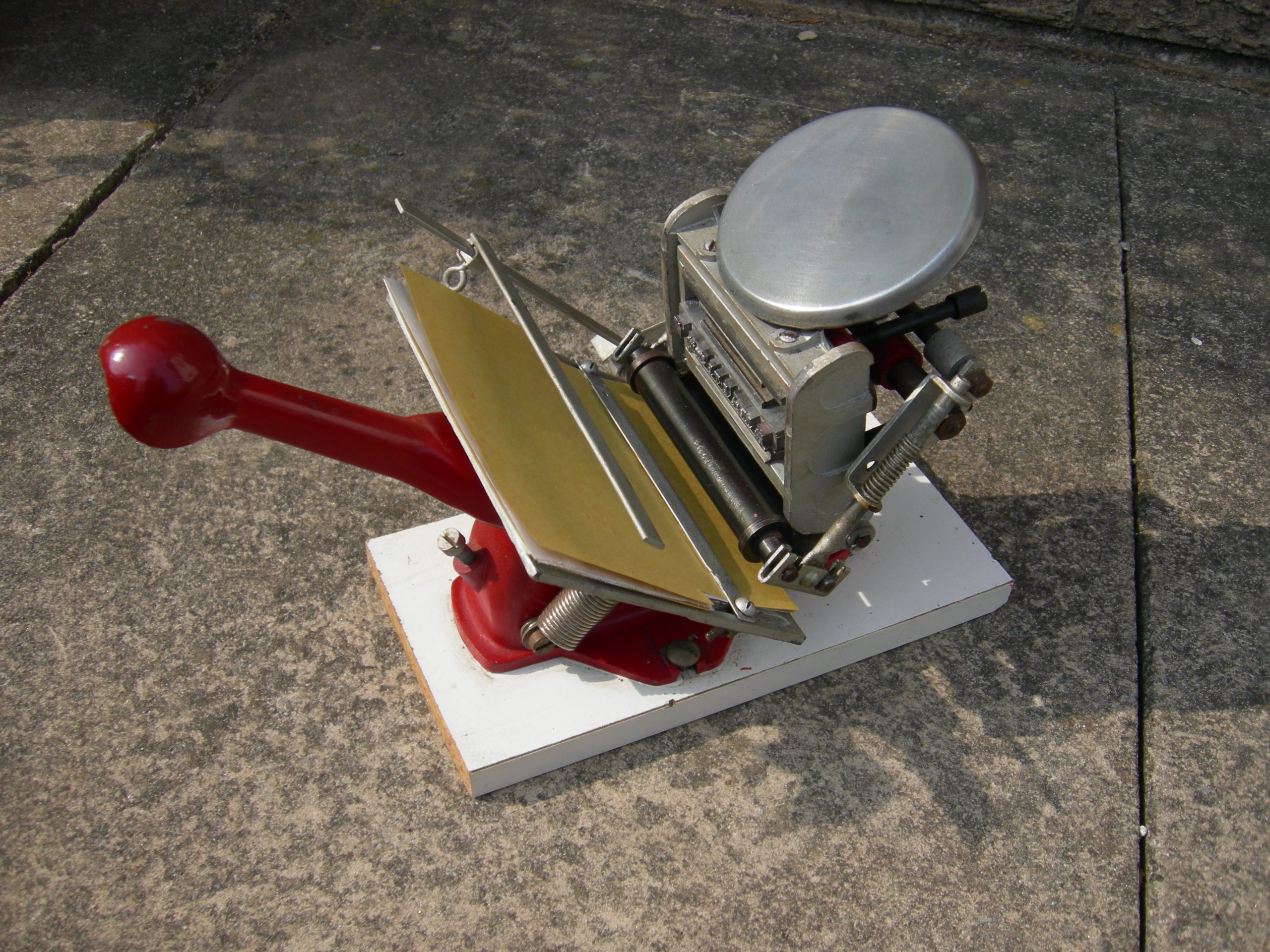
The heavier professional machines, designed to print formes involving bold type and blocks generally have a set of rollers dedicated to distributing and preparing or ‘milling’ the ink and another set, the forme rollers, which apply that ink to the type. The lighter treadle or powered ‘jobbing’ platens and the table-top hand platens make do with just one set of, usually only two, rollers to perform both functions. The sheer simplicity of table-top platens such as Adanas and those small treadle or powered platens with an ‘impression throw-off’ allows one to fool their basic mechanisms into behaving as though they have at least twice as many rollers which results in a better ink film and, thus better printing. By running a thinner film of well-loosened ink and rolling the forme twice or more for each impression your little press will produce far better work.
The builders of larger platen presses spent a lot of money on mechanisms to simulate what old hand-press printers using Albions, etc. called a ‘sinking pull’. This allows the forme to dwell in contact with the paper rather than jump straight on and off and again the result is a better printed sheet. This is easily achieved with a hand-press, whether Albion or Adana and well worth the little extra time involved.
Adanas, in particular, compromise inking to allow one to print on paper larger than the platen. To keep the roller tracks below the platen the metal or plastic runners at the ends of the rollers are of larger diameter than the actual roller. The surface speed of the roller over the type is thus different from that of the runner which results in the roller skidding slightly across the type which causes ‘ink slur’ rather than an even coating. If printing paper sufficiently smaller than the inner width of the chase, one can overcome this by fitting a fairly thick piece of wood rule, to act as a ‘type-high bearer’ for the rollers, at each end of the chase. This will also necessitate removing the ‘patent head-lay’ fitted to most Adanas (since its ends would crush the rule), and using traditional front or head and side-lays. These can be either quads glued to the tympan, slips of folded card attached with masking tape, or if you are lucky enough to find some, metal gauge pins, some of which are adjustable, which are pushed into suitably placed holes pricked or slit into the top sheet of the tympan.
Adana’s head-lay and frisket gripper fingers are infamous for crushing the type of the unwary — converting to card lays attached after taking a proof impression is part of the answer. The 8 x 5 has two frisket fingers which are best replaced by stretching the sort of rubber band the postman drops on your front path between the frisket arms. This will not damage the type of the absent-minded, but will still lift the printed sheet clear of the type forme.
This guide kindly contributed by John R Smith of the Old Forge Press. Originally appeared in the newsletter of the Oxford Guild of Printers
-

Adana QH
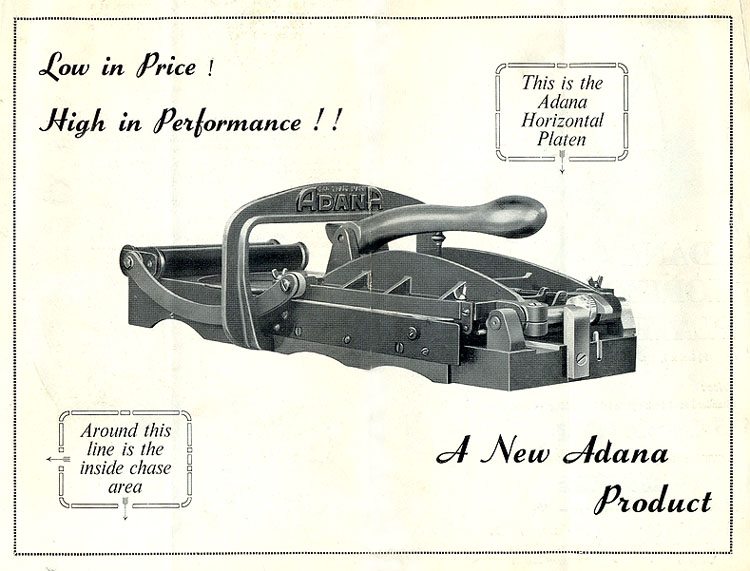
Adana QH Advert “The ultimate Adana flatbed” is how Bob Richardson describes the Adana QH (which is also referred to as the Adana HQ). The machine is capable of a large printing area (9.75″ x 7.25″) but speed of output is slow. This dissuaded the jobbing printer from using this machine; but it was taken up by art colleges and those wishing to experiment. John Ryder’s ‘Printing for Pleasure’ makes a great case for the QH — the flat bed allows simpler locking-up; and for inking to be carried out selectively. There are many who consider the inking mechanism inadequate and remove the arms to allow hand-inking by roller.
The Adana series of flatbed machines began in 1922, and the QH was the last in that series. The immediate predecessor of the QH was the ‘QFB-1945’. The QH initially came out in 1949 without an inking disc, and a single, large roller. By 1957 this was phased out in favour of a rotating ink disc and two smaller rollers. Adana discontinued the machine in 1985.
The QH has a number of refinements: there screw in the back of the platen prevents too much force being applied to the forme; and an eccentric rod at the hinged end allows for adjustment to create a level printing surface. The press is commonly called the Adana HQ, but the firm’s catalogues state that the machine is called the ‘Adana QH’.
These machines are more sought-after and appear on the market less frequently than Adana’s vertical platen machines.
-

The Adana 8 x 5
In June 1953, the Adana Eight-Five was unveiled costing £16.80. There have been a total of three variants –
- Mk I: A two-part frame with each roller on an individual spring-loaded arm
- Mk. II: (c. early 1960s) A two-part frame with rollers held on a single, sprung T‑arm
- Mk. III: (c. early 1970s) A frame in one part with the single, sprung T‑arm
This press is probably the most popular amateur press in the UK. In addition there has been a hot foil version of the machine.