

More print-related historical photos from the Gentle Author in this look at Sangorski and Sutcliffe, bookbinders.
Tag: Bookbinding
-

Brignell Bookbinder
Graham Bignell runs short courses, based principally on bookbinding.
25 Gwydir Street ‚Cambridge ‚CB1 2LG -
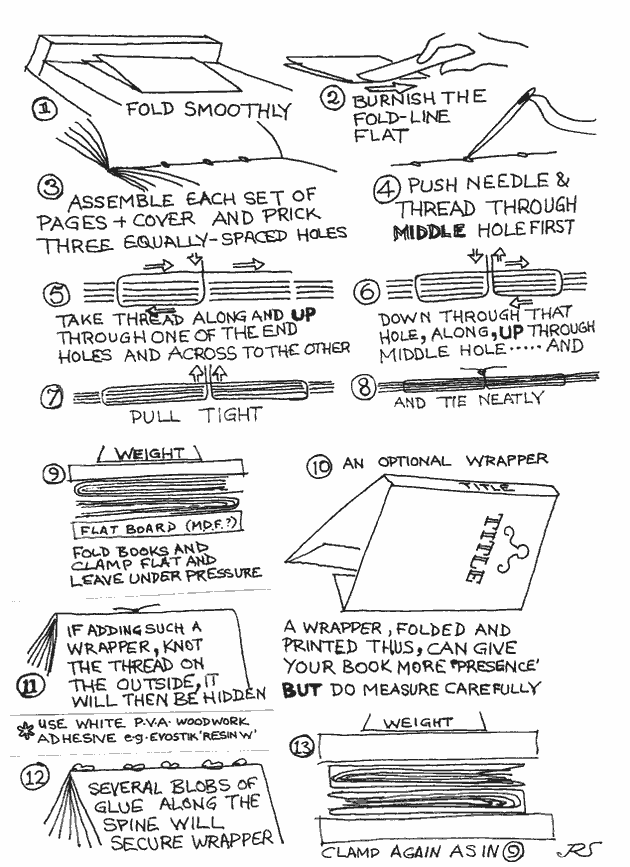
Simple Bookbinding
If you are thinking of assembling your folded pages using a domestic or office stapler, think again. Such machines use clumsy rectangular-section mild steel staples which are prone to rust. Bindery wire stitchers use slimmer wire, which for publications meant to last can be copper or stainless steel — much less likely to corrode and rot the paper. We should therefore learn and apply simple skills no longer practised by the mass-producers
This will be sufficient to deal with a contribution to the Jubilee project [An OGP initiative]. A multi-section binding is not really more demanding — it just takes longer — and there are helpful books, new or second-hand; recreational classes at certain local adult education centres will take you further.
Notes on Binding This article by John R Smith of the Old Forge Press
-

Other Arts
Going from idea to printed page is a complex process that wraps in a large number of other disciplines. Some are pretty obvious: the need to bind work into books, or to wrap packages well.
It’s strange to think of some of the other arts attached to printing: the management and layout of a printing office; the union and staff relations were all specialist areas in letterpress printing, and this section sheds a little light on them.
-

Beginning Bookbinding
It may seem complicated, but it’s a great feeling to see your newly attached boards close softly onto the freshly printed pages you’ve just sewn together. And in fact it’s not really as complicated as it may appear. Whilst full leather goatskin bindings with intricate gold tooling may look intimidating, beautiful books can be produced with good quality cloth or a mixture of cloth and tough papers. Many fine press books are produced this way. You could spend a fortune buying top quality leather, but the good news is that you can begin bookbinding with a kit that will cost a fraction of the price of a 5 sq. ft. goatskin hide.
The following kits are available –
- Hewits Bookbinders starter pack
This contains everything you need to get going (except paper). With VAT and delivery it costs roughly £60. The quality of the items is not as high as most of the things that Hewits sell, but there again, since mistakes are going to be made at least you’re not going to be wasting expensive stuff. The quantities are quite generous, so you can make lots of books without have to reorder immediately after your first attempt. They have a link on their site to making a single signature book to begin with, but after that you’ll have to buy a beginner’s bookbinding guide. - As well as these two suppliers, the other main one in the UK is Shepherds/Falkiners They have a good range of tools, cloths, leather etc., plus a wide range of paper.
Other Items You’ll Need
As well as the basic items available in the starter kits you’ll need some sort of a press. Before investing in a proper book press, there are other options. I use a flip-top workbench for holding books whilst working on them (this folds up to 90 degrees to hold wood for planing, but will hold a book well enough). These cost from £15. To press a book you need quite a lot of pressure. Heavy weights will do, but a press is more convenient and efficient! I made one from two wood planks, lined with hardboard and the pressure comes from some wide diameter threaded rod, locking nuts, washers and wing nuts. The whole thing cost less than £10, a good stop gap until you want to fork out for an authentic nipping press. If you have to sew up books with a lot of signatures or you are sewing many copies of one book, then you’ll definitely need a sewing frame. But to start with you can get by without one.
There is information about making a frame at the first link below.
Useful links
- Evilrooster Bookweb contains lots of useful information for beginners, including all the tools you need and how to make basic tools, good books, how-to guides etc.
- Christopher Swingley’s Pages These contain more helpful information for the beginner, including making tools.
- Book Binding Courses Eden Workshops has a list of available courses in the U.K.
This guide written by Jonathan Cooper of the River Seven Press
- Hewits Bookbinders starter pack