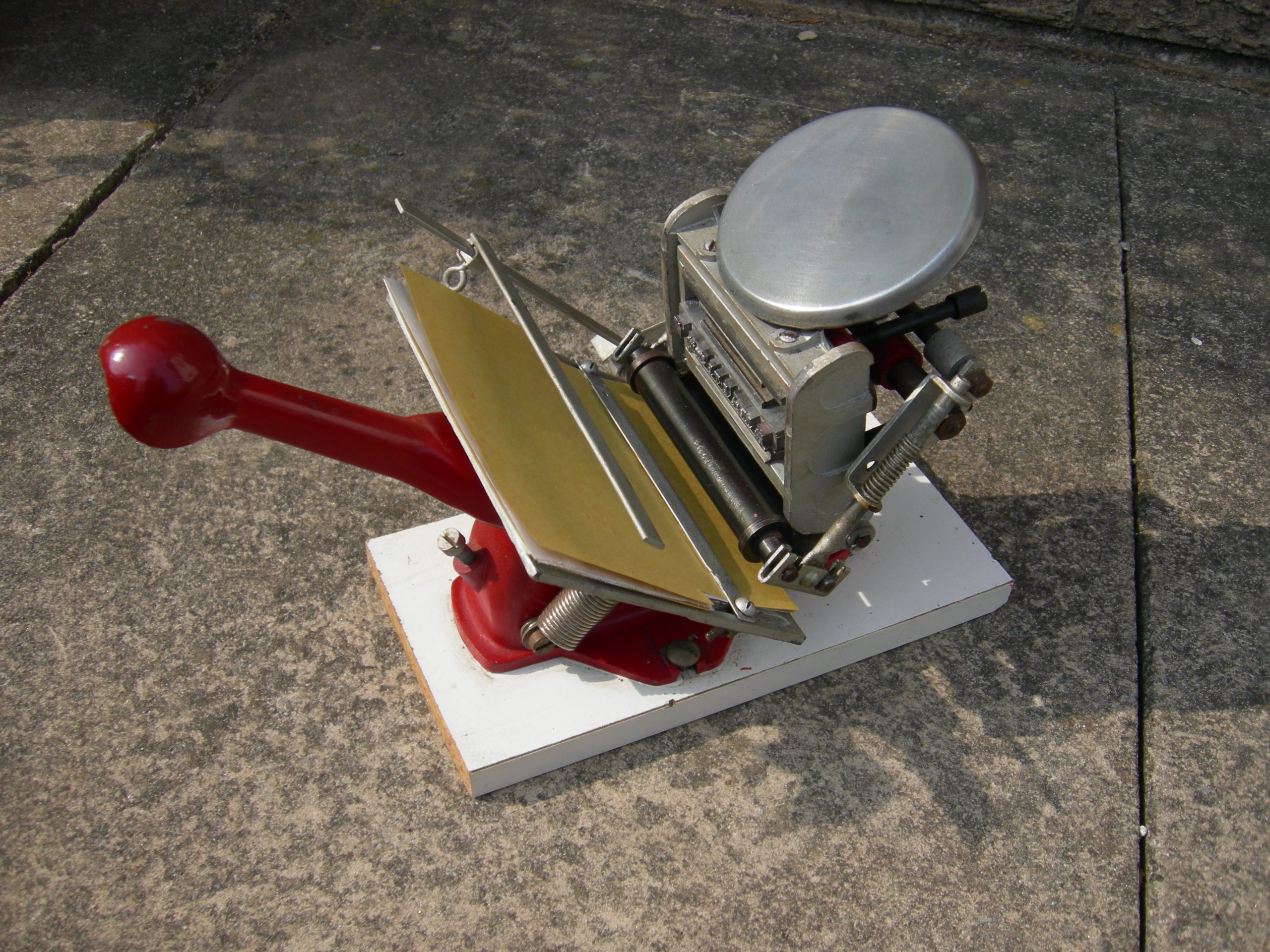
For those wishing to print letterpress, the choice is wide-but it’s all second-hand, nowadays. Ads in news-sheets such as the Oxford Guild of Printers and that of the British Printing Society, local auctions and eBay provide leads. All the type you are likely to be offered is of a standard height, so interchangeable between machines of differing size and make. Prices are essentially negotiable, there being no ‘book’ or ‘official’ scale it is simply a matter of arriving at a figure acceptable to both parties.
Small presses requiring little space, which can be lifted by one or two people and carried in a private car are more in demand and thus cost more. That includes most bench-mounted hand-presses, smaller treadle-platens and smaller galley presses. Never intended to print more than roughly-inked readers’ proofs, few galley presses incorporate any means of accurately positioning paper and are best suited to short run posters, smallish lino-cuts, etc. Some, such as the later Farley series, with adjustable impression height, autolift, grippers and feed-board, and occasionally with a primitive self-inking system can, with great care, produce consistent high-quality results; relatively light and compact, these are worth seeking. Superficial rust is easily cleaned but the resilient ‘clothing’ of the impression cylinder should be sound. This ‘rubber coating’ can be replaced, but measure up and get a quote.
Appearance can affect price, the more decorative machines fetching more than their austere counterparts. The first generation of iron hand-presses, with horizontal platens — Albions, Columbians, Imperials, etc. are much sought after, in their smaller sizes, as ikons of interior decoration and tend to pass a genteel retirement in carpeted printing works foyers or enthusiasts’ drawing rooms. Their current value is thus around 500 times what they were deemed worth 50 years ago. Like professional view-cameras, they are capable, in well-informed sensitive hands, of high quality work of amazing versatility, but demand a well-planned almost ceremonial approach. For texts they definitely constitute ‘the long way round’ — if you regularly make coffee in a Cona you will probably enjoy using one; if the ‘destination is more important than the journey’, stick with self-inking vertical platen and cylinder presses.
The prices of most other presses bulkier than the smallest treadle platens reflect the space required to house them and, perhaps more important, the cost of hiring special equipment — or professional help — to carry them. Awkward locations necessitating hoists and some dismantling to get a machine out of its current home can reduce its value to zero, irrespective of condition. Once you have learn’t your way around them, larger professional machines can more easily deliver high quality printing than their small cheaply built counterparts. Some, when new cost the price of a decent car when a small Adana cost the price of a wheelbarrow! If you have space, a machine which owes little more than the cost of transport can thus prove a good bargain.
However, few of us require high speed — even by 1950s standards — the ability to hand-feed paper of awkward shape and substance being our priority. So the mechanical complexity of fast production machines requiring expert maintenance might be best avoided. The better-class hand-fed platens to consider include the Arab, treadle or power-driven and the much heavier, powered Vicobold and similar art-platens. But using an treadle platen demands good co-ordination of hands and foot; operators of un-guarded platens frequently lost a finger or two in the bad old days!
Perhaps the most versatile-and easiest to use and maintain are the precision repro. presses of the 1950s and ’60s. Most common are those by Vandercook, their British copies by Western (later re-badged as S.B. Pre-Press), FAG and Littlejohn.
All feature a dressable cylinder, allowing precise make-ready, single-phase power inking which is easily dis-connected to allow hand-inking when required, and precision hairline register with micrometer adjustment. The smaller ones, printing around 15 x 22 inch have a hand-wound impression cylinder, larger ones, up to four times that size have power-driven cylinders, usually 3‑phase; converters are available.
The smaller ones, occupying a 6–7 x 3 foot space, weigh around 12cwt. and can be loaded via the powered tail-lift of certain hire-firms’ vans or pick-up trucks. They can be rolled over hard surfaces using suitable lengths of scaffold pole or hired machinery skates and will pass through domestic doorways (with handles of machine and door removed). Two people can, with a little thought move, install and level them without problems — the larger ones require more of everything-other than cash! Several firms can re-clothe the ink rollers. Most of the more precise wearing parts are obtainable new, as Vandercook spares, from the USA, most other bits and pieces can be repaired by ‘blacksmith’ technology or found in engineering suppliers or motorcycle shops — again, try Yellow Pages.
As with all things…caveat emptor!
Additional Notes