Tag: Moving Machines

  • Taking an Arab Apart

    Taking an Arab Apart

    This is an account of dis­man­tling a Crown Folio Arab Plat­en. The machine is ear­ly (Ser­i­al Num­ber 1086 c. 1892) but has had a num­ber of safe­ty fea­tures fit­ted. The guide below shows the major steps and will be added to. There’s a spe­cial sec­tion at the foot of this page about the brak­ing sys­tem.

    The main body of the Machine

    The start­ing point: a com­plete Arab

    Arab: com­plete machine with spare Arab Wheel” shown

    Ink­ing Disk Removed (remem­ber to replace the bolt under­neath).

    Arab: Ink­ing Disc Removed

    Feed board removed

    Arab: feed boards removed

    One of the ink­ing arms removed. Remem­ber that they are under the pres­sure of a spring so you have to keep hold of the arm as you release. In prepa­ra­tion for this you should have removed the rollers and stocks; and also removed the met­al bar which links left and right roller arms: keep this safe!

    Arab: ink­ing arms removed

    Over-arch­ing guard removed by unbolt­ing one site of the guard bars (not pic­tured)

    There are two strong springs which force the front plat­en towards to back plat­en. These need to be un-hooked while the front plat­en is almost ver­ti­cal. The two col­lars and hooks on the plat­en site need to be loos­ened so that the bar can be slid out lat­er on.

    Arab: Plat­en Springs Removed (look­ing from front to back under the machine)

    The two bolts on the left of the front plat­en must be removed so that the front plat­en is held only on the sup­port­ing bar. Remove the sup­port­ing bar and lift the front plat­en out. This is fair­ly del­i­cate as it will still con­tain the frisket motion.

    Arab: front plat­en removed

    The Arab wheel can now be slid from left to right and removed from the machine

    Arab wheel removed

    The rock horse’ is now removed. This is the U‑shaped met­al cast­ing which forces the front plat­en upwards. This rests in two slots is the frame cov­ered by two semi-cir­cu­lar cast­ings bolt­ed down.

    Arab: rock horse removed

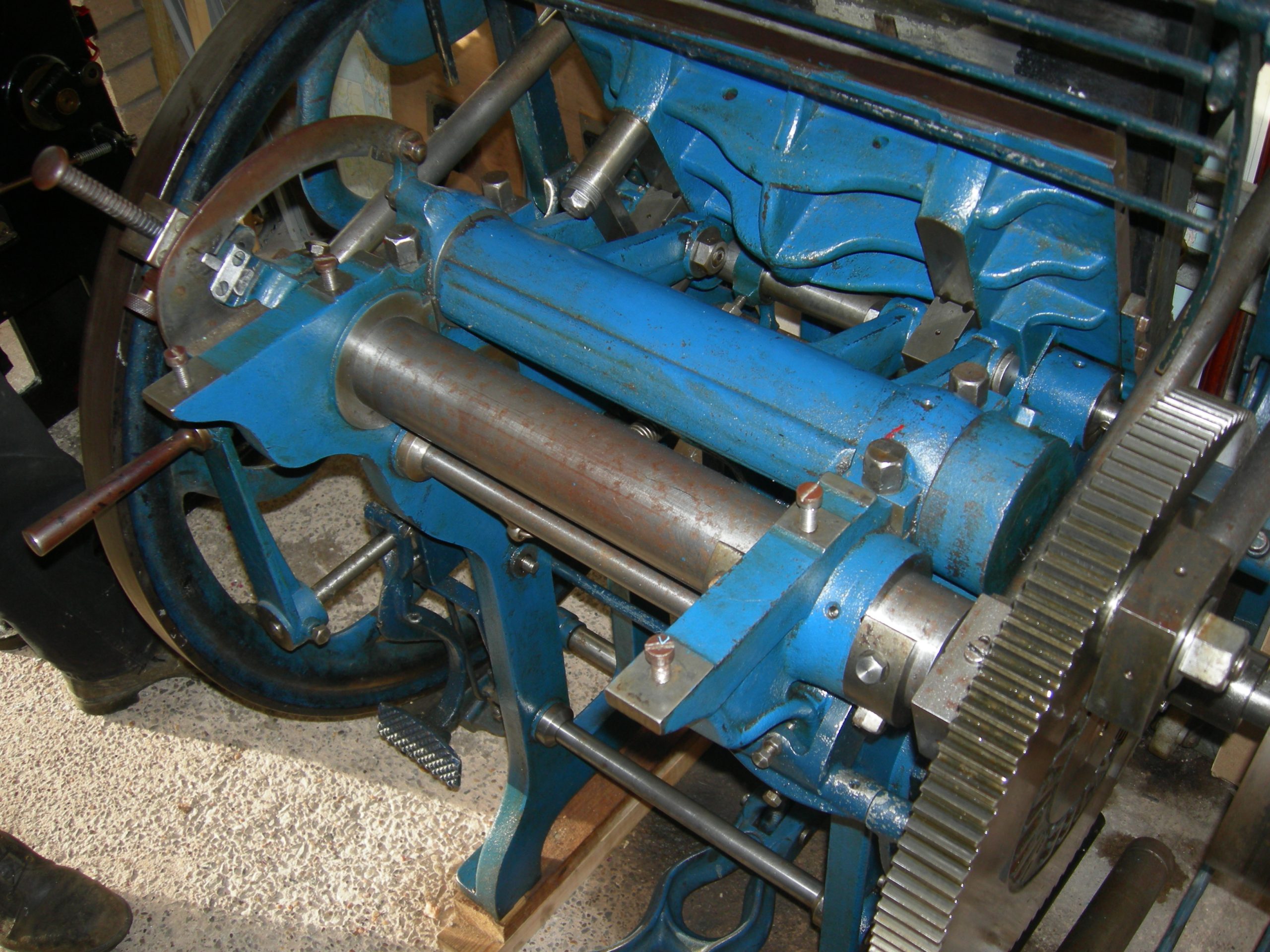
    The back plat­en is now removed as a sin­gle large unit: includ­ing the plat­en and the sup­port­ing cast­ing. This is very heavy but will save trou­ble because the back plat­en will not have to be re-adjust­ed. The eccen­tric is also removed: this is the rod which holds the impres­sion lever.

    Arab: back plat­en removed

    The braking system

    Side view of the brak­ing sys­tem

    Arab: brak­ing sys­tem from side

    Top view of the brak­ing sys­tem

    Arab: top of brak­ing sys­tem
  • Buying and Running an Arab

    Buying and Running an Arab

    The Arab is a mix of cast-iron frame; steel rods and brass. Machines were fet­ed for their reli­a­bil­i­ty and stur­di­ness. They have to be kept well-oiled and clean. When buy­ing, look out for –

    • cracks in the frame (dif­fi­cult to repair)
    • jud­der on open­ing the plat­en (could be a symp­tom of sig­nif­i­cant wear in the bear­ings)
    • any loose­ness of the plat­en: test by try­ing to pull the plat­en apart from the forme when closed up

    The machine body was paint­ed in Roy­al Blue’ but debate con­tin­ues about the exact shade, and whether dif­fer­ent shades were used. The brass roller arms were the only part of the machine to be paint­ed Pil­lar Box Red’. While the machine alone is great, also look out for –

    • man­u­als or erec­tion instruc­tions
    • addi­tion­al chas­es — the Arab came with full-size and but­ter­fly’ chas­es; or even this slant­ed chase
    • roller stocks and bear­ers (per­haps for a third roller)
    • spare parts

    Dismantling an Arab

    This is a rever­sal of the erec­tion instruc­tions and is based on expe­ri­ence. Remem­ber to keep parts togeth­er as far as pos­si­ble (eg replace nuts on bolt ends as soon as they are removed) and keep things in whole, com­plete ele­ments — like the brak­ing mech­a­nism — remove this as one unit.

    1. Ink­ing mech­a­nism
    2. Feed boards
    3. Tym­pan — by remov­ing the blan­ket rod and wire
    4. Forme Ink­ing Equip­ment
      1. Ink­ing roller bar, ink­ing rollers and run­ners
      2. Roller brass­es — care­ful of the springs
      3. Swinger bars which hold the
      4. Ink­ing disk and bear­er
      5. Ink disk pick lever
    5. Safe­ty Guard
    6. Arab Wheel should be loos­ened
    7. Spring and Plunger to hold the Chase on the back plat­en
    8. Con­nect­ing Rods
    9. Back Plat­en
      1. Low­er the back plat­en
      2. Remove the bolts from the foot of the back plat­en legs
    10. Fly­wheel — remove with nut (may have left-hand thread)
    11. Trea­dle and con­nect­ing rod
    12. Frisket mech­a­nism
      1. Strap Guide Rod
      2. Blan­ket and Frisket shafts
      3. Frisket springs
    13. Die Plate and Bush­es — this is the thing which holds the rock-horse against the plat­en
    14. Remove springs from the Plat­en Hooks
    15. Front plat­en — by remov­ing the rod, and col­lect­ing the plat­en hooks
    16. Remove the Arab wheel all togeth­er
    17. Impres­sion adjuster
    18. Eccen­tic shaft (con­nect­ed orig­i­nal­ly to the impres­sion adjuster)
    19. Rock horse
    20. Crank shaft — orig­i­nal­ly con­nect­ed to the fly­wheel
    21. Clutch and trip link
    22. Remove the bolts on the stays
    23. Take one side from the oth­er

    Re-Erecting the Arab

    You can start work on get­ting the machine back togeth­er by fol­low­ing the orig­i­nal instruc­tions that came with each machine.

    Documentation

    The orig­i­nal doc­u­ments that came with each Arab have been con­vert­ed to PDF files by Steve Fish­er and Ben Wein­er. The Arab Parts List should be used with the Erec­tion Instruc­tions