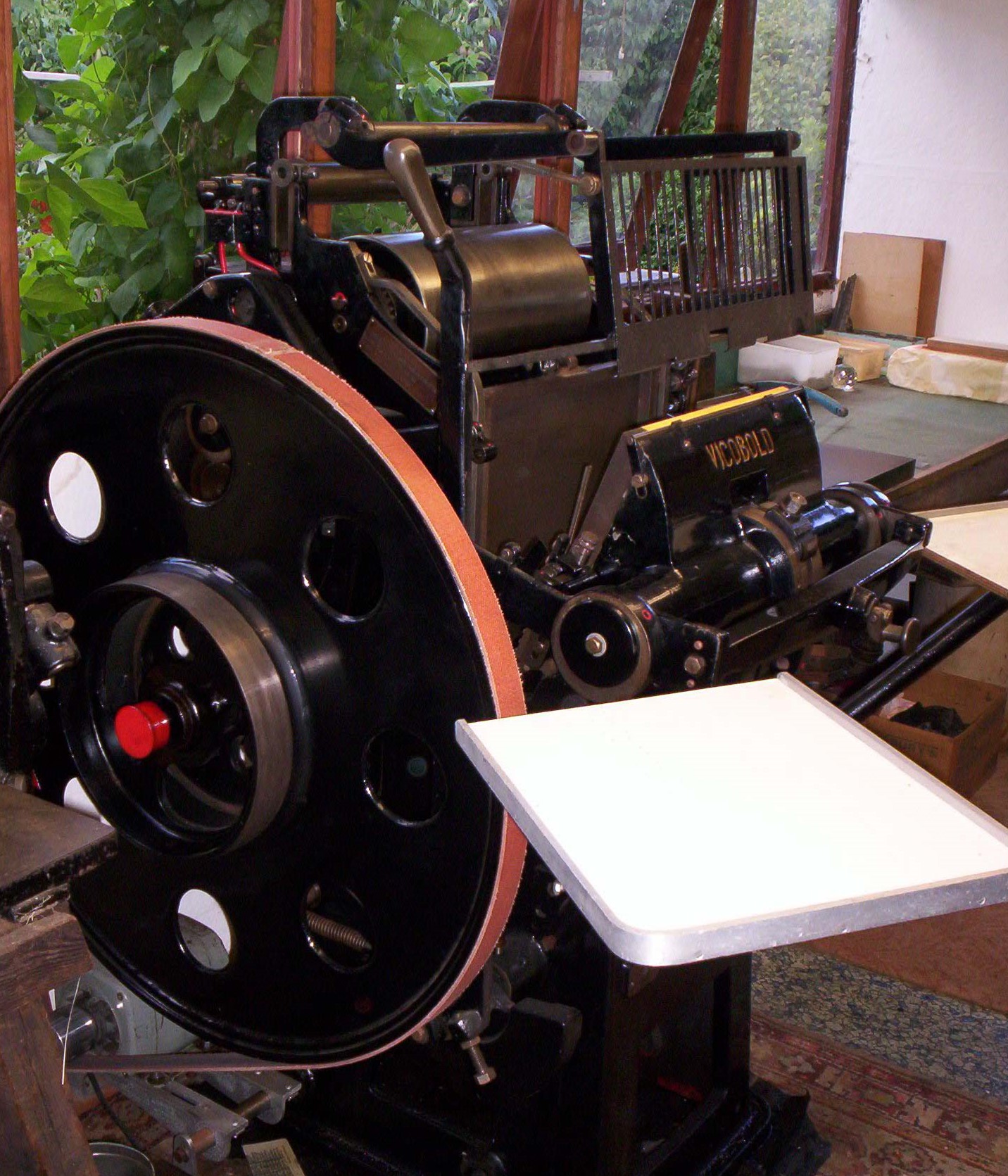
Tag: Platen Press

  • Gary Arber, Printer

    Gary Arber, Printer

    Let­ter­press-only print­ers are becom­ing increas­ingly dif­fi­cult to find.  Where this was once the only way to print and each town could boast of such a works, I have only seen a hand­ful in my let­ter­press adven­tures across the UK.  In York­shire, I saw the final days of Ken McWhan’s in Scar­bor­ough and saw the demise of Paul Mitchell of Fars­ley near Leeds.  The exem­plar blog for me is Spit­al­fields Life, and I was thrilled to see the Gen­tle Author pay a vis­it to Gary Arber on Roman Road in East Lon­don.

    I was less pleased when I saw that Mr Arber’s Print­ing Works was near clos­ure, so I took the chance to vis­it him.  I can’t do the same jus­tice as the Gen­tle Author to this won­der­ful sto­ry, fron­ted by Mr Arber, but I can as the ques­tions that I sus­pect print­ers would want me to ask, and also offer my best wish­es for his future.

    I spoke to Gary on Wed­nes­day 19 Feb­ru­ary and asked whether I could vis­it.  Some print­ers are almost furt­ive but Gary said he would wel­come a vis­it.  I made the short jour­ney from the bow­els of the City of Lon­don on the Num­ber 8 to this dif­fer­ent world.  The fact that the light above the door states Print­ing Works” leaves the dis­tinct impres­sion he means busi­ness.

    The visitor’s first impres­sion is the wealth of objects — every­where.  Each sur­face is filled with enga­ging and inter­est­ing things.  Sta­tion­ery, eph­em­era, odds-and-sods from the print works itself.  This ground floor is Arber’s shop win­dow and the place to deal with cus­tom­ers.  Gary was help­ful to the trick­le of cus­tom­ers that still attend in hope of solv­ing some com­mu­nic­a­tion need — des­pite the rather dra­conian park­ing restric­tions.

    Machine Room

    I was escor­ted down the small, steep stairs to the base­ment.  It’s here that the machines live that print­ers will have sal­iv­ated over in the Spit­al­fields Life art­icle.  The usu­al print­ing smells of oil and ink are here, but also the cold slight­ly damp air and qui­et that comes with being below street lev­el.  I could see that work has begun to remove these machines to Nor­folk and the renewed care of the Cat­seye Press, but the bulk of the bat­tery was here.

    Work­ing from under the stairs, the room con­tains the now-famous Lagon­da, the Heidel­berg Plat­en, a Superm­atic’, Wharfedale, Mer­cedes Glock­ner, and a small Gold­ing Press.

    De­cid­ing on Machines

    I asked Gary how he decid­ed on which machine to use for a job and his response was sim­ple: tiny jobs like busi­ness cards would be done on the Gold­ing; lar­ger jobs on the Heidel­berg and the largest jobs on the Wharfedale.

    The Lagonda’

    The Lagon­da has attrac­ted a lot of atten­tion — it’s one of those machines that few peo­ple have seen and had attained an almost myth­ical sta­tus.  The machine was installed in the 1950s, while Gary was in the Roy­al Air Force, but was nev­er very pop­u­lar.  The feed mech­an­ism is dri­ven by a long, sin­gle bar run­ning from left to right and this was tempre­mental.  An impres­sion of the last job remains on the tym­pan — a bot­tle label for oil — and the machine was last used around 1968.  The Brit­ish Print­er write-up of the Lagon­da sug­ges­ted they could be run side-by-side, but the way the motor hous­ing is posi­tioned leads me to believe that this could nev­er have been done in prac­tice.

    The Heidel­berg

    With the excep­tion of Steve Fish­er (who raves about the Thomp­son Plat­en), the ranks of com­mer­cial job­bing let­ter­press print­ers fall in love with their Heidel­bergs and Gary is no excep­tion.  This machine is his go to’ machine and has been used until the last two weeks.

    Gold­ing and Wharfedale

    These two machines are fam­ous from their con­nec­tion with the suf­fra­gettes.   It’s these two machines used to print for the cam­paign.  I was espe­cially tak­en with the size of the Wharfedale (Crown sized: 20? x 30?) — such small machines are unusu­al accord­ing to Bri­an Aldred.

    Case or Composing Room

    The stairs adja­cent to the front door lead upstairs to the com­pos­ing room.  Three men worked here at one time: each with his own stand of cas­es.  The room looks slight­ly domes­tic with red and gold wall­pa­per but this is what the comps liked, said Gary.  It looks rather chaot­ic, and I sup­pose that the demands of work over time meant that very lit­tle type seems to have been returned to its case.

    Type Selec­tion

    Gary told me that his sup­plier of choice was Risca­type, of Mon­mouth­shire.  He con­cen­trated on Gill for the sans face and Times for the ser­iffed face.  A small run of Rock­well and Per­petua sup­ple­ments this.

    Gen­eral Lay­out of the Works

    The works was at one time all based in the base­ment machine room: with case racks and com­pos­it­ors work­ing along the back wall and machines on the out­side wall.  As the busi­ness expan­ded, the guil­lot­ine and case racks were moved to a shed in the back yard.  From there they were moved to the back of the shop’ area on the ground floor.  Even­tu­ally the case room was moved upstairs in to what was the liv­ing area.  Gary told me that a Factor­ies Inspec­tor in the 1970s had sug­ges­ted the works was not up to stand­ard: includ­ing the need to guard most use­ful ele­ments of the machine, replace the stair­case to the cel­lar and white­wash the case room.  Gary declined and end­ed up let­ting go of his staff to avoid fur­ther enforce­ment by the Inspec­tor.  The case room, by the way, retains the ori­ginal wall­pa­per!

    The Future

    Gary Arber in the Case­room

    Gary’s works have been pro­du­cing prin­ted mater­ial since 1897 and the won­der­ful human sto­ry that fol­lows this is best told by the Gen­tle Author.  It was a pleas­ure to meet Mr Arber and to find him so will­ing to indulge my hob­by printer’s curi­os­it­ies.  Gary’s machines each have a new home pen­cilled in, and I wish the chaps at Cat­seye Press the very best with dimant­ling, mov­ing, restor­ing and oper­at­ing these frag­ments of a mosa­ic that cov­er print­ing, the East End, the Suf­fra­gettes and Mr Arber him­self.

    I did ask whether I might indulge him with some­thing for his hos­pit­al­ity, but Gary — it seems — has no vices!

    Best wish­es, Gary, for the next chap­ter of life away from your Print­ing Works.

    Update: April 2014

    The nice chaps from the Cat­s­eye Press have been in touch with me –

    Once we have it installed and cleaned (quite a lot) We will be more than hap­py for peo­ple with an inter­est to vis­it our Lagon­da Plat­en (as removed from Arber’s in Roman Road) Along with our exten­sive col­lec­tion of oth­er plat­en and cylin­der machines.

  • Heidelberg Platens

    Heidelberg Platens

    It’s these press­es that you’ll see in many mod­ern print­ing works.  They have a ver­sa­tile auto­mat­ic feed but the machines are more often used for cut­ting, creas­ing and num­ber­ing than for print­ing.  Sec­ond-hand machine often have had their ink­ing equip­ment removed.

    The machine uses air suc­tion to pick up paper — con­trast this with the Arab which had no auto­mat­ic feed even for the last machines pro­duced in 1959.  The suc­tion sys­tem uses two arms — one lift­ing paper from the stock while anoth­er draws paper that’s just been print­ed away from the plat­en.  This mech­a­nism gives the press the nick­name the wind­mill’.  While the small print­er will use lay gauges to posi­tion paper on the plat­en, dif­fer­ent Hei­del­berg mod­els used dif­fer­ent approach­es — the paper was held by the wind­mill while print­ed; or was dropped on to lays on the plat­en; or was shift­ed in to posi­tion by reg­is­ter guides.

    Ink­ing is through two forme rollers with an option­al rid­er roller.  Ink reach­es the forme rollers from the duct, via. a duct roller; four rollers and then to the ink­ing drum which rec­i­p­ro­cates.

    There was a gap in sales dur­ing World War 2, but new British machines fol­low­ing the war were sold as Orig­i­nal Hei­del­bergs’.  In 1957 the machine cost £1000 and was sup­plied with instal­la­tion and a week’s worth of guid­ance from the man­u­fac­tur­er.

    In 1958, two mod­els of press were avail­able badged as Orig­i­nal Hei­del­berg” platens.  Their spec­i­fi­ca­tions; along with the 1958 pub­lic­i­ty are shown below.

    Heidelberg Platen Specifications

    Orig­i­nal Hei­del­berg 10″ x 15 Orig­i­nal Hei­del­berg 13″ x 18
    Largest Paper Size 10.25″ x 15 13.375″ x 18.125
    Small­est Paper Size 1.5″ x 2.75 3.5″ x 4
    Inside Chase 10.25″ x 13.375 12.625″ x 17.75
    Max­i­mum Run­ning Speed 5,000 iph 4,000 iph
    Floor Space Required 58″ x 311 49″ x 66
    Pow­er Required 1.1kW / 1.5hp 1.5kW / 2.5hp
    Net weight 2,400 lbs 4,600 lbs
    Impres­sion­al Strength 40 tons 60 tons

    Original Heidelberg 10″ x 15

    Heidelberg 10 x 15
    Hei­del­berg 10 x 15

    Original Heidelberg 13″ x 18

    Heidelberg Platen (13" x 18")
    Hei­del­berg Plat­en (13″ x 18″)
  • Vicobold Machines: Victoria Platens

    Vicobold Machines: Victoria Platens

    These press­es are of Ger­man descent — made by Rock­stroh-Werke AG of Hei­de­nau — but were made in the UK by Frank F Per­shke.

    Rock­stroh-Werke AG made three mod­els of machine -

    • Vic­to­ria (Mod­el B’)
    • Auto-Vic­to­ria (Mod­el C’)
    • Kobold

    The three UK-made mod­els were -

    • Vicobold
    • Autovi­cobold
    • Autovic

    Infor­ma­tion from Frank F Per­shke adverts is repro­duced below. The address giv­en was Dover House, 170 West­min­ster Bridge Road, Lon­don SE1

    General Principles

    The key fea­ture of these machines is that they employ a par­al­lel plat­en’ approach. The platens are not hinged (like most oth­er press­es), but runs on rails in the ver­ti­cal posi­tion. This ensures that impres­sion is even over the face of the forme.

    Ink­ing is by a rotat­ing cylin­der at the head of the machine — rather than an ink­ing disk. The machines are based on the Vic­to­ria Heavy Art Plat­en.

    Vicobold

    Machine Max Sheet Size Inside Chase Size Plat­en Size Space Occu­pied Pow­er Required Net Weight
    Vicobold 10.25″ x 14″ (26 x 35.5cm) 9.5″ x 13.25″ (24 x 33.5cm) 11″ x 14.25″ (28 x 36cm) 49″ x 47″ (124 x 120cm) 0.5hp 8.5cwt (425kg)

    This machine is hand-fed and fol­lows the same prin­ci­ples as the oth­ers in the series. Ink is sup­plied to the ink­ing drum through a screw con­trolled duct, and trans­ferred to the forme with two rollers. Impres­sion strength can be changed with a sin­gle nut at the back of the plat­en: the par­al­lel approach takes care of all of the forme with that one change.

    There were at least two mod­els — the Mod­el C’ which was motorised; and a Mod­el T’ run with a trea­dle.

    Autovicobold

    Machine Max Sheet Size Inside Chase Size Plat­en Size Space Occu­pied Pow­er Required Net Weight
    Autovi­cobold 10.25″ x 14″ (26 x 35.5cm) 9.5″ x 13.25″ (24 x 33.5cm) 11″ x 14.25″ (28 x 36cm) 38″ x 62″ (97 x 219cm) (with auto feed­er in posi­tion) 1.5hp 13cwt (650kg)

    This machine is essen­tial­ly the Vicobold with an auto­mat­ic feed and deliv­ery sys­tem. A sell­ing fea­ture was that the feed and deliv­ery sys­tem could be wheeled away when need­ed: allow­ing the machine to be used as a hand-fed machine, and also to allow open access to the work­ing area dur­ing set-up.

    Autovic

    Machine Max Sheet Size Inside Chase Size Plat­en Size Space Occu­pied Pow­er Required Net Weight
    Autovic 13.375″ x 18.125″ (34 x 46cm) 13.5″ x 17.75″ (34.5 x 45cm) 14.25″ x 18.875″ (36 x 48cm) 56″ x 65″ (141 x 165cm) (with auto feed­er in posi­tion) 1.5hp 24cwt (1220kg)

    This machine is a larg­er size than the oth­er two mod­els, and occu­pies a sub­stan­tial­ly larg­er space. It was sup­plied with an option­al feed sys­tem. Ink­ing is by means of three rollers: two are in con­tact with then forme on the way down’, and the third roller is engaged with the form only on the way up’. There are two addi­tion­al rollers in the ink­ing mech­a­nism for ink dis­tri­b­u­tion. An auto­mat­ic wash-up sys­tem is also includ­ed.

  • The Arab

    The Arab

    The Arab is claimed by some to be the finest hand-fed plat­en in the World. In terms of cost and weight, it out-per­forms oth­er machines; and the fact it is designed to be dis-assem­bled and rebuilt makes it eas­i­er to trans­port than oth­er, sim­i­lar, press­es.

    Models

    There were two major mod­els of the Arab: in Foolscap size (13″ x 9″ chase — 16cwt) and Crown Folio size (15″ x 10″ chase — 18cwt). A third size was made (21″ x 14″ — Demy Folio — 21cwt), but few, if any, sur­vive.

    History

    The Arab was cer­tain­ly inspired by the George Gor­don’s Press, and accounts tell us that Josi­ah Wade had import­ed a num­ber of press­es from Amer­i­ca to study. One expla­na­tion for the close link between the Franklin Press (invent­ed by Gor­don) and the Arab is that the two men shared a voy­age between the UK and Amer­i­ca. Gor­don was keen to make mon­ey from his Patents, and Wade was already on the periph­ery of the print­ing busi­ness. Wade bought the patents, designed the cast­ings, and made some improve­ments.

    The Patent of 1872 for the Arab indi­cates that the machine had ten nov­el fea­tures beyond the cur­rent state of the art includ­ing leather roller bear­ers to secure bet­ter ink­ing; spe­cial guides for the paper on the plat­en; and a way of con­trol­ling dwell’. This dwell issue was impor­tant: sim­ple press­es just open and close. Wade’s design allowed the plat­en to stay open longer (mak­ing for eas­i­er feed­ing of paper), and dwell to last longer (for a bet­ter impres­sion). This errat­ic move­ment was pos­si­ble even with the con­stant and uni­form speed of a trea­dle or belt dri­ve. The Patent shows a gear mech­a­nism used to get this motion; but most mod­els includ­ed a more sim­ple wheel run­ning with­in a cam. This sits behind the large cog stamped J Wade Paten­tee, Hal­i­fax’.

    The Arab is a clamshell plat­en’, and works by bring­ing togeth­er both the forme’ of type; and the plat­en hold­ing the paper. The back plat­en moves on an axis at the foot of the machine.

    Press reports of 1872 — re-print­ed in the Print­ers’ Reg­is­ter from the Hal­i­fax Guardian — show that Wade had named the machine The Arab’. The view at the time was that the Arab race was hard-work­ing and reli­able. I assume that the term Anglo-Amer­i­can’ was lat­er added to secure appeal on both sides of the Atlantic.

    The Arab was sup­plied in parts like mod­ern-day flat-pack fur­ni­ture. It was built in the black’ (unpaint­ed); run at the works and adjust­ed; paint­ed, pol­ished and coat­ed in oil; re-erect­ed when the forme was adjust­ed; and then dis­man­tled and packed. Wade offered to send the machine along with a man to build it; but the instruc­tions claimed that any man com­pe­tent with a screw­driv­er could build the thing. The weight of each part could be car­ried by a man; but per­son­al expe­ri­ence tells me that strong men are need­ed, espe­cial­ly when dis­man­tling. This approach also cut trans­port costs and might be one fac­tor in the spread of the machines over the civilised world’. Indeed, the Hal­i­fax Couri­er report­ed that Wade’s machines were on the Shack­le­ton Expe­di­tion

    Wade was invit­ed to send an exam­ple of his press to the Patents Muse­um in Lon­don in Decem­ber 1881 to con­trast with ear­li­er press­es. The Hal­i­fax Couri­er report­ed that Wade was pleased with this acco­lade, as it demon­strat­ed the qual­i­ty of what could be pro­duced in the North of Eng­land.

    The 1920’s mod­els of the press show a sol­id wheel in place of the spoked fly­wheel — pre­sum­ably to reduce acci­dents; and a sin­gle bar to move the hand away from the plat­en dur­ing feed­ing.

    Arab Advert (c. 1940)

    Twen­ty years beyond that, in the 1940’s, a new guard that wrapped over the top of the plat­en was intro­duced; but many felt this got in the way of work­ing, and it was often removed. A clutch re-set­ting sys­tem was improved; and a full-width ink duct fit­ted.

    The final mod­els (Mod­el A’) includ­ed the facil­i­ty to inch’ the motion of the press with a motor and boast­ed that 1,200 impres­sions per hour could be had. Geof­frey Osborne points out that there was nev­er a mech­a­nism for auto­mat­ic feed­ing of paper to the Arab, and this was a cru­cial in the declin­ing pop­u­lar­i­ty of the machine.

    Pro­duc­tion stopped in Hal­i­fax in 1959 and the inter­ests of the firm were sold to Wells­man and Par­ry in Liv­er­pool. When they closed, the firm was sold to Excel­sior in Lon­don. Excel­sior were sell­ing Arab parts until at least May 1984; and pos­si­bly trad­ing until 1986.

    Press Timeline

    August 1872 The Arab” Patent­ed: report­ed in Hal­i­fax Couri­er, and the Print­ers Reg­is­ter. The machine was to be exhib­it­ed by Mr Pow­ell of Bou­vi­er Street, Lon­don
    1874 Arab pro­duc­tion moved from Well Head Lane, Hal­i­fax to Hop­wood Lane where Wade built Crown Works’. Lat­er to move to Hope Works on Arun­del Street
    1881 Wade invit­ed by the Patent Muse­um, Lon­don to pro­vide a spec­i­men of the Arab
    1903 Wade buys the Dunkirk Mills Estate, Hal­i­fax to match the expand­ing busi­ness
    1908 In reports of Josi­ah Wade’s death, ref­er­ence is made to agents for Wade in Liv­er­pool and South Africa, amongst oth­er places
    1920s The machine is char­ac­terised by a sol­id fly­wheel, a hand-guard made of a sin­gle ris­ing rod, and new impres­sion adjust­ment
    1940s A new guard (look­ing like a cage) is fit­ted, a full-width ink duct, and clutch re-set­ting sys­tem is added
    1950s Mod­el A’ is devel­oped, which is motorised and offers addi­tion­al guards and inch­ing’. The press remains with­out a sys­tem for feed­ing paper
    1959 Wade clos­es in Hal­i­fax, hav­ing made around 40,000 machines. The firm is bought by Wells­man and Par­ry of Liv­er­pool
    Ear­ly 1960s ISPA News reports that Wells­man and Par­ry con­tin­ued to make the machine until the ear­ly six­ties.

    Further Information

    Key sources for this page are -

    • Geof­frey Osborne arti­cle in Matrix Win­ter 1984
    • Hal­i­fax Couri­er and Hal­i­fax Guardian from Feb­ru­ary 1908
    • BPS Small Print­er Mag­a­zine, re-print of ISPA News from 1962
    • LETPRESS list

    Contributors

    These peo­ple have passed me infor­ma­tion on the Arab -