Tag: Platen Presses

  • Haddon and the Introduction of the American Point System

    Haddon and the Introduction of the American Point System

    Arti­cle by Tony King

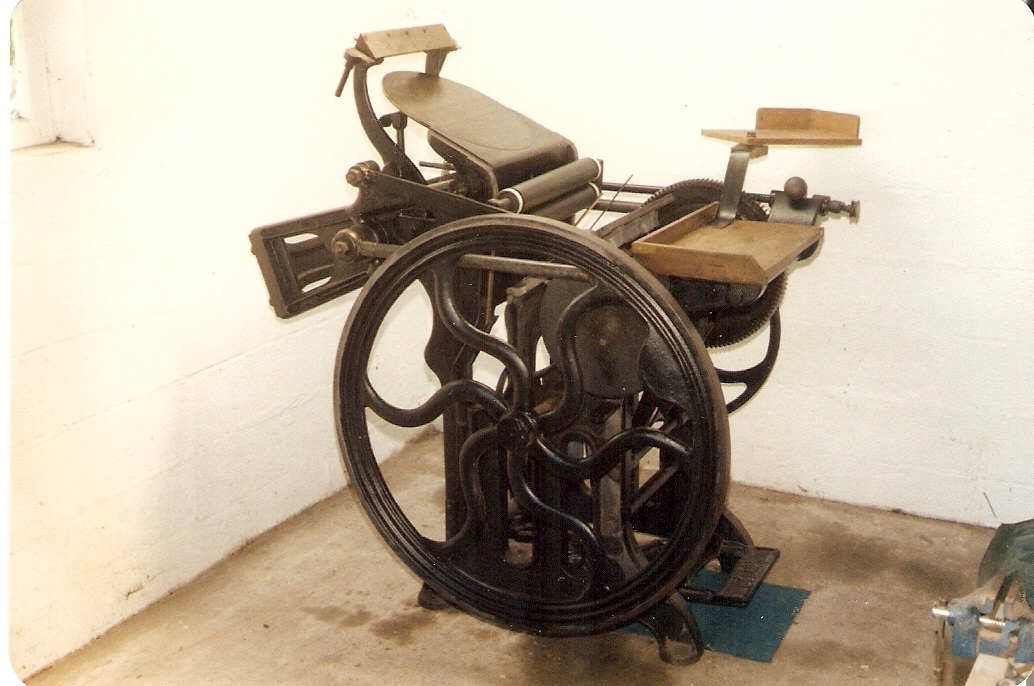
    I bought a Had­don Gor­don 15 x 10 in 1985 after years of tread­ling a C & P, and was curi­ous to know the lin­eage of this par­tic­u­lar brand. I was famil­iar with Arabs, Crop­pers, and oth­er Gor­dons but not the name of Had­don.

    My research found that Had­don was the lead­ing advo­cate for the adop­tion of the Amer­i­can point sys­tem in Eng­land which saw its pro­gres­sive intro­duc­tion at the turn of the 19th cen­tu­ry. Not only an advo­cate but the entre­pre­neur­ial flair of Wal­ter Had­don saw him over­whelm the mar­ket — and nat­u­ral­ly cause an uproar in the cast­ing indus­try.

    My ear­ly research traced my press­es’ life in New Zealand to the New Zealand rep­re­sen­ta­tive for John Had­don & Co of Mar­ket Har­bor­ough, Eng­land. This was A. D. Willis a print­er and importer in Wan­ganui high­ly respect­ed in Aus­trala­sia in the 1880’s for his exquis­ite lith­o­graphed scenic post­cards of New Zealand. Short­ly after buy­ing the press I vis­it­ed Wan­ganui to buy cas­es of redun­dant type from a newspaper’s loft, and dis­cov­ered with some amaze­ment that the build­ing car­ried the foun­da­tion stone for A. D. Willis, Print­er.

    Haddon Gordon Platen Press
    Had­don Gor­don Plat­en Press

    In 1989 I vis­it­ed the St Brides Library in Lon­don and start­ed my research in earnest, lat­er to be sup­ple­ment­ed by a great deal of infor­ma­tion from a 1914 issue of the British Print­er in which they were mark­ing the cen­te­nary of the estab­lish­ment of the Had­don busi­ness in 1814.

    The record­ed Had­don dynasty which was based in Nase­by Northamp­ton­shire goes back beyond 1700, and the lin­eage fathered sev­er­al John Had­dons and the one that even­tu­al­ly start­ed the print­ing empire was one of 11 chil­dren and born in 1823.(18231904) The fam­i­ly were farm­ers but John born in 1784 (17841855) did not have farm­ing incli­na­tions but was not­ed for his lit­er­ary tastes although it was as a busi­ness­man that he made his mark. He was appren­ticed to a print­er at the age of 15 (1801) and after a year went to Lon­don to seek his for­tune.” In 1814 he found­ed the print­ing busi­ness which cel­e­brat­ed its cen­te­nary in 1914. His ear­ly print­ing includ­ed much for Bap­tist mis­sion­ar­ies espe­cial­ly lit­er­a­ture for for­eign mis­sions in which his father was also par­tic­u­lar­ly inter­est­ed. They saw the poten­tial of spread­ing their busi­ness ambi­tions beyond print­ing and the British Isles and often had requests from mis­sion­ar­ies to be sent items in addi­tion to their books and pam­phlets. As a result they estab­lished a gen­er­al com­mis­sion agency’ which gave them the oppor­tu­ni­ty to be in touch with all parts of the world.

    The third John born in 1823 was also appren­ticed as a print­er and super­seded his old­er broth­er to become the sole pro­pri­etor in 1855. How­ev­er his pas­sion for print­ing was over­shad­owed by his inter­est in phil­an­thropy, reli­gion, music and gar­den­ing and the busi­ness suf­fered as a result. He bowed out of an active inter­est in the com­pa­ny when in 1888 cousin Wal­ter Had­don joined the firm as a part­ner and became the sole pro­pri­etor in 1890. At that time there were three employ­ees, by 1898 one hun­dred.

    Wal­ter pos­sessed the qual­i­ties to turn the for­tunes of the com­pa­ny around and his entre­pre­neur­ial skill had him expand­ing the busi­ness, acquir­ing well estab­lished engi­neer­ing com­pa­nies that would com­pli­ment his future direc­tion. He estab­lished an adver­tis­ing agency, and devel­oped the skills of direct mar­ket­ing and mail order

    In 1898 in an inter­view with The British & Colo­nial Print­er & Sta­tion­er he spoke of the frus­tra­tion of many print­ers in not hav­ing a uni­ver­sal type cast­ing stan­dard in Eng­land and he’d observed from his con­tacts in Amer­i­ca and from type that had been import­ed, the advan­tage of the stan­dard devel­oped in Amer­i­ca. The Amer­i­can sys­tem was the work of Nel­son Hawks a print­er in San Fran­cis­co when in 1871 he pro­posed the estab­lish­ment of uni­form body sizes, but it was not until 1886 that the Amer­i­can Sys­tem of Inter­change­able Type Bod­ies was accept­ed. Caslon were first of the mark in 1886 announc­ing a scheme for the new body mea­sure­ment and it was offi­cial­ly adopt­ed in Eng­land in 1889. Had­don came on the scene in 1897 with a vengeance:

    For more than half a cen­tu­ry this reform has been dis­cussed, but per­sis­tent­ly and stub­born­ly resist­ed, if not ignored by type­founders. Repeat­ed­ly have print­ers com­plained of the incon­ve­nience, the annoy­ance, the expense, to which they have been need­less­ly put by the pol­i­cy of the founders in the mat­ter of each hav­ing dif­fer­ent stan­dards. No notice has been tak­en of their com­plaints, their rea­son­able­ness and grav­i­ty could not be denied, but no rem­e­dy was offered until type from Amer­i­ca and oth­er for­eign foundries found its way into this coun­try and was eager­ly pur­chased by print­ers.”

    Behind the resis­tance was the cost of con­vert­ing to the new sys­tem and Had­don had his ene­mies. An Asso­ci­at­ed Type Founders lob­by group appeared attempt­ing to under­mine the momen­tum for the new point sys­tem. Known as the Ring” by Had­don sup­port­ers, Wal­ter chose to use his Type Cat­a­logue of 1902 to chal­lenge them through­out his type sam­ple pages. In Had­don Old Style he says The Ring’ Founders cast type to indef­i­nite widths, and so jus­ti­fi­ca­tion of the larg­er types is again a mat­ter of odd­ments of lead, pieces of card or paper, spiked quads and much waste of time and mate­r­i­al.”
    In 1898 Wal­ter estab­lished his mas­sive Cax­ton Type Foundry at Mar­ket Har­bor­ough in Leices­ter­shire, and trum­pet­ed the virtues of the sys­tem to the indus­try. His foundry cov­ered two and a half acres and includ­ed not only type cast­ing but the pro­duc­tion of a full range of print­ers’ tools, acces­sories, wood type and cab­i­nets and by now his work­force had reached 1500.

    His brash adver­tis­ing and aggres­sive mar­ket­ing was com­ment­ed upon in The British Print­er: Although the meth­ods of pro­mo­tion adopt­ed at the time were, to put it gen­tly, some­what of a shock to the estab­lished trade, and tru­ly were far from com­mend­ing them­selves to many mem­bers of the print­ing indus­try it will be accept­ed that the Had­don foundry had the courage of its con­vic­tions and cer­tain­ly did not mince mat­ters either in argu­ment, adver­tis­ing, in claims and in replies to oppo­nents.” Wal­ter trav­elled through­out Britain and to the Con­ti­nent extolling the virtues of the new point sys­tem and the supe­ri­or­i­ty of the type from his new foundry – and found will­ing con­verts wher­ev­er he went. Accord­ing to H.W. Larkin in Com­pos­i­tors Work in Print­ing’ some print­ers were still using the old body type as late as 1935.  And while giv­ing pri­or­i­ty to the pros­per­i­ty of the Cax­ton Foundry, the com­pa­ny con­tin­ued to devel­op the Export and Buy­ing Depart­ment that had been the begin­nings of inter­na­tion­al trade back in the ear­li­est days of mis­sion­ary trad­ing.’ Trade was exten­sive in both direc­tions act­ing as a buy­ing agency in Eng­land and Europe for the Indi­an and Colo­nial cen­tres every­where in export­ing motor cars and motor cycles, cloth­ing, hard­ware, pro­vi­sions, and ammu­ni­tion” while sourc­ing buy­ers in Eng­land for prod­ucts from planters and store­keep­ers in Asia, the West Indies, the South Sea Islands, Aus­tralia, New Zealand Cen­tral and South Amer­i­ca and Con­go Belge”. In 1894 they struck a boom in the export of rub­ber plants, nur­tured from seedlings in Eng­land, to Cey­lon and the Malay States, and were the first to intro­duce and import crepe rub­ber into Eng­land. They also import­ed ele­phants and rhi­noc­er­os to order from Africa.

    The man­u­fac­ture of zinc and cop­per plates for process’ pur­pos­es had up until about 1914 been con­fined to Amer­i­can and Ger­man sources. Had­don acquired a cop­per and zinc plate fac­to­ry in Clapham and became the only works of its kind in the British Empire, and pro­duced a very high stan­dard of plate. Demand from Eng­lish print­ers and engravers was over­whelm­ing and fur­ther enhanced the rep­u­ta­tion of the Had­don brand.

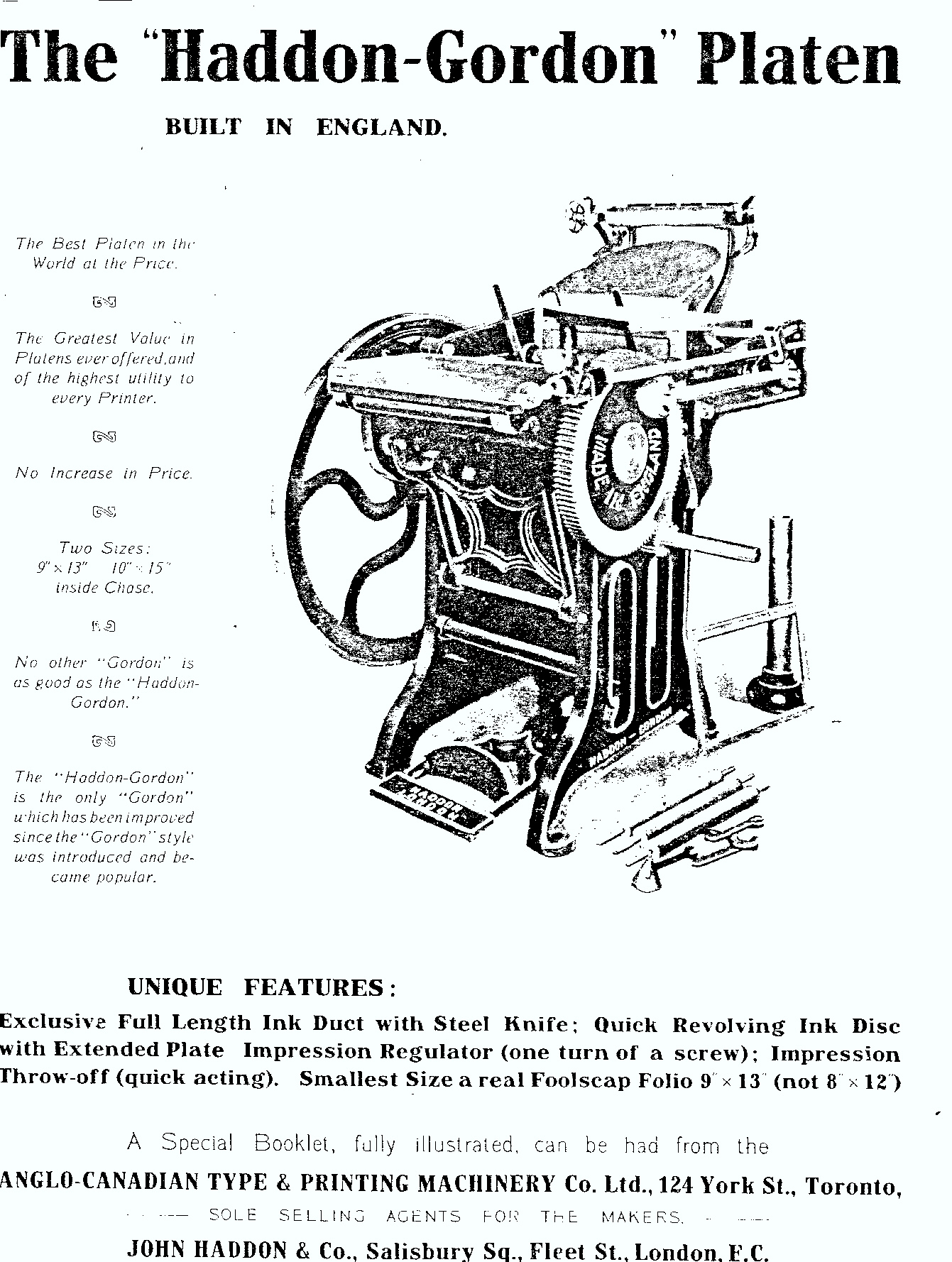
    Haddon Gordon Advert
    Had­don Gor­don Advert

    The Had­don-Cax­ton Types, Bor­ders, and Rules cat­a­logue on 1902 lists the press­es avail­able at that time as the Had­don High Speed Safe­ty Plat­en, the Bab­cock Stan­dard Drum Cylin­der press, The Bab­cock Opti­mus, The Art Cax­ton Platens and Swift Platens.

    The trea­dle and lat­er motorised Gor­don platens appear to have been man­u­fac­tured from about 1861, the Min­er­va built by H S Crop­per appear­ing in 1867 and by 1894 no less than eleven firms were man­u­fac­tur­ing Gor­don press­es. This would sug­gest my favourite 15 x 10 Had­don Gor­don could be about 115 years old.

    Ref­er­ences: The British Print­er (an issue of 1914)
    British & Colo­nial Print­er & Sta­tion­er March 24 1898
    Had­don the Head Hunter – A.Hingston-Quiggin 1914
    His­to­ry of the Haddon’s of Nase­by – W. G. Croft 1915
    Com­pos­i­tors Work in Print­ing – H. W Larkin 1961
    Had­don-Cax­ton Types and Bor­ders Cat­a­logue 1902

    The Dor­man Asso­ci­a­tion has doc­u­ment­ed more infor­ma­tion about the man­u­fac­tur­er of the Had­don Press.

    This arti­cle and pho­tos cour­tesy of: Antho­ny R. King

    Tony King start­ed let­ter­press print­ing as a school­boy on an Adana HS2 in 1953 print­ing just two issues of a four page Third Forms Mini Mag” before resort­ing to adding pages dupli­cat­ed from an Emgee Memo Stamp” dupli­ca­tor. Years lat­er – career and fam­i­ly inter­vened – he import­ed an Adana HQ and sub­se­quent­ly moved to a C & P 15 x 10, Pearl trea­dle, Kelsey 9 x 6, Adana 5 x 3, and Had­don Gor­don. Today at his home in Grey­town, north of Welling­ton N.Z. he oper­ates an Adana HQ, Adana 8 x 5, Adana HS2, a 1910 Sig­walt No 11, and Far­ley Proof press, and at the Grey­town Ear­ly Set­tlers Muse­um opened a print shop in July 2010 based around a Chal­lenge Gor­don 15 x 10 (1894) and T.C. Thomp­son (Man­ches­ter) Gem No 3 (1926); Pen­rose Proof press, and two Adana HS No 2. Tony is a foun­da­tion mem­ber of the Asso­ci­a­tion of Hand­craft Print­ers (New Zealand), and mod­er­a­tor of the Yahoo Group let­ter­press­du’ (let­ter­press down under).

  • History of the Jobbing Platen

    History of the Jobbing Platen

    After the 1830s, the growth of the postal ser­vice and the expan­sion of com­merce led to growth in demand for small, print­ed arti­cles.  The Job­bing Plat­en met this need for the print­er: being quick­er than the ear­li­er hand press­es; and more suit­ed to small work than cylin­der press­es. It’s tempt­ing to think that the plat­en press sim­ply appeared — ful­ly formed — but there were many small advances that made that style of press pos­si­ble. Daniel Tread­well, an Amer­i­can, sought an 1818 patent to pro­tect his design for a mod­i­fied hand press that used foot pow­er (like a trea­dle) to deliv­er the impres­sion.  He trans­ferred the inven­tion to Eng­land and the firm of Baisler and Napi­er made the machine at their works at Lloyds Court, Crown Street, Soho; but only one is report­ed to have been sold.  The rotat­ing ink disc was invent­ed between 1819 and 1820 by Sir William Con­gereve for secu­ri­ty print­ing.  John Kitchen of New­cas­tle Upon Tyne patent­ed the ver­ti­cal forme in 1834.  It seems the machine would not have been com­mer­cial­ly suc­cess­ful, but was designed in the style of goth­ic church fur­ni­ture”.

    The First Usable Platen

    Stephen Rug­gles, from Boston USA, devel­oped the Engine press in 1839 but the bed and plat­en were hor­i­zon­tal.  Despite this, the press claimed 1,200 impres­sions per hour.  It was his devel­op­ment of 1851 of the Card and Bill­head Press” that opened the era of the first usable plat­en: this relied on his strange ink­ing mech­a­nism.  The approach is to have a large cylin­der, flat on one side for the type.  The cylin­der is cov­ered in ink and as the rollers pass around it, they draw ink from the cir­cu­lar part of the cylin­der and deposit it on the forme.  This press was made in Britain by the Birm­ing­ham Machin­ist Com­pa­ny as the Invic­tus and also Fur­ni­val and Com­pa­ny of Red­dish.  The prin­ci­ple was lat­er adapt­ed by Adana for their T/P48.

    The Modern Platen

    The pro­to­type plat­en press was devel­oped by George Gor­don of New York.  His ear­ly press (1851) was named The Alli­ga­tor because of its rep­u­ta­tion of crush­ing limbs of those feed­ing the press.  This first ver­sion had a fixed ink­ing pan­el, it was 1856 before he added the rotat­ing ink­ing disc.  In 1872, the throw off” was added: a mech­a­nism to allow the oper­a­tor to dis­able the impres­sion when a sheet had been mis-fed, for exam­ple.  Again, the idea was not new hav­ing been patent­ed in 1852 by James Young of Philadel­phia. Crop­per of Not­ting­ham began to make Gor­don’s press­es under the name Min­er­va, but the term Crop­per to define that type of press became com­mon­place.  Oth­er, local­ly designed, press­es used Gor­don’s idea like the Arab from Hal­i­fax.

    The Parallel Platen

    Improv­ing on the clam shell” approach, Mer­rit Gal­ly of New York devel­oped a press in 1859 called the Uni­ver­sal which brought the bed and the plat­en togeth­er with a par­al­lel impres­sion.  This was improved by the Vic­to­ria and Phoenix press­es.  In the UK, Green­wood and Bat­ley of Leeds sold a very sim­i­lar press under the name Sun; Daw­son’s of Otley the Mitre; and Har­rild of Lon­don the Fine Art Brem­n­er.

    The Powered, Automatically-Fed Platen

    Know­ing that the effort of a boy could not be sus­tained to thou­sands of impres­sions each hour, work began on mak­ing effi­cien­cies of space and pow­er.  In 1893, Har­rild of Lon­don cre­at­ed a plat­en press run­ning back-to-back: two mov­ing platens each print­ing against a sin­gle, two-sided, fixed bed. With steam and elec­tric pow­er, the next chal­lenge was to feed the press with paper. A grip­per was patent­ed by God­frey in the 1880s, and an auto­mat­ed feed for US Chan­dler and Price press­es was being sold by 1913.  Per­haps most known to us in the UK is the inven­tion of Gilke, a Hei­del­berg Engi­neer, who cre­at­ed the wind­mill feed in 1912 which was incor­po­rat­ed in to the 1925 Hei­del­berg Auto­mat­ic Plat­en.

  • Lagonda Platen Press

    Lagonda Platen Press

    Lagonda Platen Press
    Lagon­da Plat­en Press

    This arti­cle from the British Print­er, 1945.  I find the Lagon­da inter­est­ing because of the unusu­al design — buried under item 4 is the idea that these machines could be sat side-by-side to print colour work: four machines one each for red, yel­low, blue and black.  Per­haps an idea that, while excel­lent, came just as full-colour let­ter­press print­ing was being tak­en less seri­ous­ly. A most impor­tant devel­op­ment in auto­mat­ic plat­en print­ing press­es, embody­ing sev­er­al new mechan­i­cal fea­tures, is short­ly to be pre­sent­ed to the trade. The Lagon­da” the name of the new machine, is being man­u­fac­tured by the Lagon­da Com­pa­ny, the world-famous auto­mo­bile mak­ers at Staines, Mid­dx. This, their very first entrance into the field of print­ing engi­neer­ing, was prompt­ed by the wish of the direc­tors to main­tain their great­ly aug­ment­ed wartime staff in full post-war employ­ment. With this deter­mi­na­tion in view, the Lagon­da Com­pa­ny secured the ser­vices of Mr. F. J. Clarke, the well-known print­ing engi­neer, whose first design for them result­ed in the pro­duc­tion of the new auto-plat­en. The Lagon­da” is under­go­ing very exhaus­tive tests and imme­di­ate­ly fol­low­ing their suc­cess­ful com­ple­tion, the machine will go into gen­er­al pro­duc­tion with a view to mar­ket­ing them com­par­a­tive­ly ear­ly next year. We give below full details of the con­struc­tion, range and per­for­mance of the Lagon­da” –

    1. The Impres­sion. A full-size crown folio forme, 15 in. x 10 in. can be print­ed with­out throw­ing any extra strain on the machine. A very strong semi-steel plat­en and spe­cial­ly rein­forced ribbed main cast­ing. Microm­e­ter adjust­ment of the impres­sion is pro­vid­ed. The check action of the plat­en is con­trolled by elec­tric sole­noid and push-but­ton by the oper­a­tor. There are no levers to fid­dle with. The type bed and plat­en are ground fin­ish.
    2. Ink­ing Mech­a­nism. Every detail of the ink­ing mech­a­nism from ink duct to the forme roller has received very care­ful and sci­en­tif­ic design. Dou­ble rec­i­p­ro­ca­tion for per­fect milling of the ink is intro­duced so that the ink on the rollers is nev­er in a sta­tion­ary state. The ink drum car­ry­ing the sup­ply to the forme rollers is not large enough in diam­e­ter to car­ry sur­plus unused por­tion, there­fore vir­gin ink is always avail­able. Run­ners on the ends of the forme rollers are V‑shaped to pre­vent skid­ding over the forme, and the cir­cum­fer­ence of the forme rollers will car­ry suf­fi­cient ink to roll a full-size forme. Ink check­ing device is incor­po­rat­ed. All rollers on machine are cov­ered with a dust cov­er which can be pushed back for clean­ing.
    3. Feed and Deliv­ery. This is entire­ly a new idea embody­ing a straight fine feed and deliv­ery, both dri­ven by one com­mon mem­ber tak­ing a sheet from the pile on the left side of the plat­en and deliv­er­ing it on to the mov­ing lays on the plat­en and after impres­sion has tak­en place, the sheet is deliv­ered by grip­pers from the forme to deliv­ery table, at the right side of the plat­en. The main idea of this is to make one machine a unit of a mul­ti-colour machine, sev­er­al of which can be cou­pled up and oper­at­ed by a mas­ter switch, four or more colours can then be print­ed at one load­ing. Many of the medi­um-size print­ers have felt the need for a two-colour machine of small size. The Lagon­da auto-plat­en will give him the same result, and he can still use his two machines as sep­a­rate units when desired. There are no cum­ber­some parts in front of the plat­en, the oper­a­tor can get over his plat­en for make-ready.
    4. Main Dri­ve. The machine is dri­ven by elec­tric motor and V belt, and pro­vid­ed with three speeds (stan­dard equip­ment) or (vari­able speed con­trol extra), the belts are moved by sim­ple arrange­ment from larg­er to small­er V pul­leys, all attached to the machine. Push but­tons are used for oper­at­ing the clutch and brake, these are con­ve­nient­ly placed both in front and back of machine on a con­trol pan­el.
    5. Capac­i­ty of Work. From a vis­it­ing card to crown folio size, in thick­ness of stock vary­ing from 7‑lb. bank paper to 12-sheet board. Small formes of cut­ting and creas­ing can be done and a spe­cial steel plate pro­vid­ed to be secured to the plat­en sur­face. Spray­ing the print­ed sheet to pre­vent set-off can be sup­plied with each machine at small extra cost.
    6. Equip­ment. A full set of span­ners and screw­drivers. Two chas­es, one full size and one card chase.  One set of clothed rollers and one set of stocks. Two sets of rub­ber suck­ers for use with thick card.
    7. Sim­ple Oper­a­tion. The aim has been to pro­vide a first-class machine to run at very high speed of 5,500 prints per hour with­out vibra­tion and with sim­plic­i­ty of oper­a­tion. Any print­er can oper­ate this machine after a few min­utes’ instruc­tion. Ser­vice depots will be estab­lished in every dis­trict.

    The incur­sion of the Lagon­da Com­pa­ny into the field of print­ing engi­neer­ing is not going to stop at the intro­duc­tion of the auto-plat­en. We are informed that they have sev­er­al projects in view, and from the long con­ver­sa­tion we had with Mr. Clarke and two of his asso­ciates, much of it we regret off the record” at this ear­ly stage — we gath­er that the com­pa­ny will be spring­ing one or two more sur­pris­es on the print­ing indus­try before very long. The sole dis­trib­u­tors of the Lagon­da” for this coun­try and over­seas are The Vic­to­ry Kid­del: Print­ing Machine Co., Ltd., Clif­ford’s Inn, Fleet Street, Lon­don, E.C.4.

  • Cropper

    Cropper

    Crop­per” became a gener­ic term for all job­bing plat­en press­es in the UK. The man who gave his name to these press­es was Hen­ry Smith Crop­per, born in Rad­ford, Not­ting­hamshire in 1839. He was a suc­cess­ful busi­ness­man and also a pil­lar of the local com­mu­ni­ty. He was elect­ed to a School Board, which built local schools, was Sher­iff of Not­ting­ham from 18801881, and he was also a mag­is­trate.

    His com­pa­ny, H.S. Crop­per and Co. Ltd. made two well known press­es,

    The Minerva

    This was based on the Gor­don Franklin press and H.S. Crop­per and Co. began its man­u­fac­ture in 1867. Adverts said it was bet­ter known as The Crop­per”. In 1879 an adver­tise­ment claimed that 9,000 were in use, and by 1891, 14,000. The same adverts include a tes­ti­mo­ni­al that one own­er employed a boy who could pro­duce 2,000 impres­sions per hour. How­ev­er, James Moran thinks that even the more mod­est claim of 1,0001,250iph was an exag­ger­a­tion.

    It was avail­able in the fol­low­ing sizes; 7″ x 11″, 9″ x 14″, 10″ x 15″, 11″ x 17″, 13″ x 19″.

    The Min­er­va was famous­ly used by Vir­ginia and Leonard Woolf, to pro­duce Hog­a­rth Press books. There is a draw­ing of Leonard at the press with Vir­ginia in the back­ground com­pos­ing here. The Woolfs gave the press to Vita Sackville-West and it is still at Siss­inghurst.

    The Cropperette

    This was based on the Pearl plat­en.

    Cropper, Charlton and Co.

    Hen­ry Crop­per died in 1893, and the com­pa­ny then became The Crop­per Machines Co. trad­ing from Parkin­son Street Mills, Not­ting­ham. Short­ly after­wards, Hen­ry’s son Syd­ney went into part­ner­ship with Charles Charl­ton and the name of the com­pa­ny changed to Crop­per, Charl­ton and Co. trad­ing from Franklin Works, New Bas­ford, Not­ting­ham. Sad­ly Syd­ney Crop­per died aged only 36 in 1901, just two years after his mar­riage. Charl­ton con­tin­ued to run the com­pa­ny with his two sons, Regi­nald and Charles Cedric, not sur­pris­ing­ly they kept the Crop­per name in their com­pa­ny title. The last patent that they applied for was in 1939.

    Crop­per, Charl­ton and Co. man­u­fac­tured and import­ed a num­ber of press­es, these includ­ed –

    The Peerless

    Clamshell Plat­en in 8″ x 5″, 7″ x 11″, 10″ x 15″. The Peer­less No.2 (7″ x 11″) weighs approx 550lb. The 8″ x 5″ mod­el was sold through H.W. Caslon and an ear­ly advert claimed its unique sell­ing points were that it ” runs as easy as a sewing machine” and that the Peer­less was oper­at­ed by “.. a nov­el method, the dwell on the press is long.”

    Although bear­ing the same name as an Amer­i­can press, the design seemed clos­er to the Crop­perette than the Peer­less Plat­en man­u­fac­tured in the States by the Globe Man­u­fac­tur­ing Co., which was anoth­er Gor­don copy.

    More infor­ma­tion on Bill Elliget­t’s site.

    The Acme

    Cropper Acme
    Crop­per Acme

    As the Peer­less appears to be a devel­op­ment of the Crop­perette, so the Acme seems to have evolved from the Min­er­va.

    The Kovo (aka Adast) Grafopress

    Grafopress
    Grafo­press

    This was a 10″ x 15″. auto­mat­ic plat­en import­ed from Czecho­slo­va­kia capa­ble of 5,000 iph. It was pre­sum­ably meant to com­pete with the Hei­del­berg and Thomp­son platens.

    In addi­tion to this they cast type, as shown in this list­ing from a book sale –

    Print­ing Types. Crop­per, Charl­ton & Co., Not­ting­ham, [c1938] Pp.78;
    Includes: Chat­ton, Gret­na, Ilford, Tynedale, Main­land, Carter, &c.;
    var­i­ous bor­ders & orna­ments and Logo­types for Jock­eys & Foot­ball Clubs.

    They also made large nip­ping press­es, includ­ing one 14″ x 22″. with an open­ing of 13″.

    Sources

    • Jaco­bi, C. T. (1904) Print­ing. George Bell and Sons.
    • Moran, J. (1973) Print­ing Press­es. Faber and Faber
    • Place, J.A. and Clunes, E. (1932) — The Art & Prac­tice of Print­ing, Vol. 2, Atkins, W. (Ed.) Pit­man
    • Cen­sus Records 1871,1881,1891, 1901. (see For­dred, D.(2006), Crop­per, Charl­ton and Co. Small Print­er Vol 42, No.2)
    • Online Patent Records. (see Richard­son, R (2006)., Patent Blether Small Print­er Vol 42, No.10)
    • Snein­ton School Board
    • List of Sher­iffs
    • The Grafo­press — Print­’s Past, The Grafo­press, Print Week. Sep­tem­ber 2002.

    This arti­cle writ­ten by Jonathan Coop­er of the Riv­er Sev­en Press

  • Thompson

    Thompson

    T C Thomp­son and Sons sold the grand­ly-titled Thomp­son-British Auto­mat­ic Plat­en’, made in Bux­ton Street, Man­ches­ter. While the machine com­pet­ed with Hei­del­bergs, it still has a group of enthu­si­as­tic fol­low­ers. One par­tic­u­lar fea­ture is that the ink­ing rollers have a cog at one end which links into a bike chain on the run­ner — this guar­an­tees that there will be no slur — ink being dragged, rather than rolled, over the forme.

    In 1929 the Sales Direc­tor of Thomp­son’s — Mr Holt — saw the new Hei­del­berg; and sug­gest­ed that the firm should switch from their hand-fed Gem’ platens to an auto­mat­i­cal­ly fed machine. The new machine was first exhib­it­ed in 1937.

    Bernard Ben­nett of Coven­try offers the infor­ma­tion that the machine pic­tured is not the orig­i­nal Thomp­son. The first ver­sion was effec­tive­ly a clone of the Hei­del­berg — Hei­del­berg did­n’t like this and were suc­cess­ful in a patent infringe­ment claim and almost all of those orig­i­nal Thomp­sons were destroyed. By 1940 around four remained. Bernard also says that post World War 2, Thomp­son platens were made at the Alvis car plant in Coven­try.

    The com­pa­ny made the mod­est claim that theirs was the best auto plat­en in the world’, and sup­port­ers say that han­dling of paper stock is unpar­al­leled. Pub­lic­i­ty showed that 0.04mm (bank) to 0.94mm (board) paper could be auto­mat­i­cal­ly fed.

    Tes­ti­mo­ni­als from Hol­land stat­ed “…The sat­is­fac­tion exceed­ed our expec­ta­tions; par­tic­u­lar­ly the feed and deliv­ery. We con­sid­er this a great improve­ment on the…(German machine).” Thomp­son must have been acute­ly aware of the chal­lenge from Hei­del­berg.

    In the 1980s platens were built by two men, being built in batch­es of two.  A third man inspect­ed them.

    The firm trad­ed until the ear­ly 1990s hav­ing made 6,000 platens, spares and parts being sold to a firm in Birm­ing­ham.  The premis­es were demol­ished short­ly after.

    Bill Elligett has post­ed a page about the Thomp­son at his site