

Another series of pictures of the Caslon Letter Foundry at 22/23 Chiswell St., London. Caslon were taken over by Stephenson, Blake around 1937. Pictures from the St Bride Library via. the Gentle Author.
Tag: Caslon
-
Spitalfields Life: Caslon Letter Foundry (Part 2)
The Gentle Author again looks at typefounders, and unearths historical images of the Caslon Letter Foundry
-
Spitalfields Life: The Caslon Letter Foundry
The ever-excellent Gentle Author looks at the Caslon Letter Foundry, Chiswell Street, London
-
Stephenson, Blake
This article is about the traditional type-founding activities of Stephenson, Blake. In late 2005 Thomas Blake sold the original site and a new firm, Stephenson and Blake Limited, continue the brass rule and other brass products from Effingham Road, Sheffield
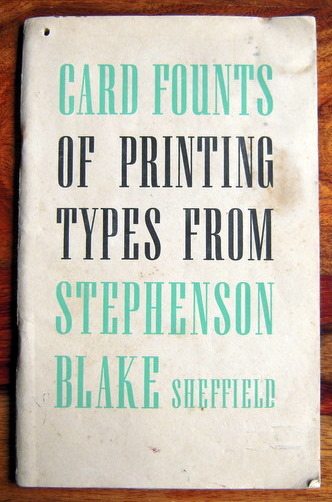
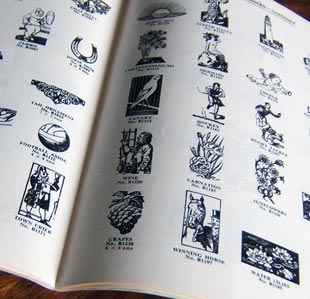
Stephenson, Blake Card Fount Catalogue The now defunct, but still famous name of Stephenson, Blake (SB) was created when James Blake and John Stephenson signed a partnership agreement on 25 September 1830 to last until 1840. The agreement was renewed, and the name persisted, absorbing many other type foundries in the intervening years. The foundry had always been based around Upper Allen Street in Sheffield
The foundry had been in Sheffield in one form or another since around 1797 when a local bookseller (John Slater) and a bookseller-printer (William Bower) joined forces with a printer (Clay Bacon) to cast type, issuing their first specimen in 1809. That founding work had persisted under many names until taken on by Garnett and Blake, and then becoming Stephenson, Blake.
Since the earliest times SB had worked to 1/5000th of an inch as a matter of course: the type they founded was considered the most precise in the UK.
A London warehouse was opened in 1865 to supply the demands of Fleet Street newspapers. Business was so good that they removed to larger London premises on Aldersgate Street in 1871.
The next major change was the move to the American Point system which had been adopted by America in 1886. Some firms in the UK were quick to adopt this change-like Caxton in 1895-it was a further four years before SB renewed their moulds and matrices to work on the point system. A key advantage for customers was that type and spacing was now interchangeable between suppliers: printers having a uniform system to measure size.
A rival founder, London-based Charles Reed and Sons hit financial difficulties and was sold in 1905 to Stephenson, Blake who offered £5,000 for the foundry, matrices and the 82 tons of stock. The purchase was effective from 1 January 1906 and the firm was known for a time as ‘Stephenson, Blake and Company and Sir Charles Reed and Sons’. The work of the Reed foundry and some equipment was shipped to Sheffield where an almost self-contained foundry existed alongside the SB equipment.
In January 1907 a Woodworking Department was established over the road from the foundry to make furniture for composing rooms and type cases. A year later the production of wood letter was brought in-house and examples first appeared in the specimen books of 1910.
All type founders were affected by the Great War of 1914–1918 and this led to further rationalisation in the industry. Discussions began with H W Caslon about an amalgamation, but this did not reach a successful conclusion at this time. Caslon’s factory had been used to manufacture items needed for war, and this provided financial help to take them out of the financial problems. Building on this, Caslon issued a booklet called Two Centuries of Type Founding which the wider industry admired.
Stephenson, Blake reacted by engaging Robert Fishenden to produce the most ambitious specimen book ever devised. Seven hundred pages were hand-set in London, shipped to Stephenson Blake and then to West Street where the printer‑J W Northend Ltd-had the task of taking proofs. These were inspected by H K Stephenson and R G Blake before being committed to print on two hand fed quad-demy Miehle machines. The quality of the result was highlighted when the book was reviewed by the Times Educational Supplement. J W Northend was told that SB would take their business elsewhere if they moved to mechanical composition, and Northend resisted this until the 1970s.
In 1936 SBs main competitor‑H W Caslon-had again met financial difficulties and went in to voluntary liquidation. Stephenson, Blake bought the goodwill, assets and punches of Caslon, and retained the name by calling their Sheffield premises The Caslon Letter Foundry.
World War II had a great effect on the foundry: not only because many men were called up, but air raids disrupted the business. In December 1940 air raids meant that gas, electricity and water were lost to the foundry in Sheffield. R G Blake had ensured that casting machines were ready for work at his home, and these were used for casting until mains services returned in January 1942.
Post 1950 the Woodworking Department had expanded to provide a full service to composing rooms and many prestigious orders were executed including the Sunday Times’ composing room in 1973.
Following the trends of the industry Stephenson, Blake found it difficult to remain a letterpress business in face of competition from litho machines. They diversified by offering the ‘Letterphot’ system of photo typesetting; and turning the wood operations to the manufacture of precision instrument cases. The firm’s precision engineering team was used by Rolls-Royce Olympus to produce moulds for parts for Concorde.
The firm found it difficult to pay business rates on the sprawling collection of buildings around Upper Allen street and began to divest themselves of them, including knocking some down. Re-location was considered to Derbyshire to avoid this overhead.
Just before 2000 the firm sold its non-printing businesses and Thomas James Blake looked to re-launch the firm. For a time the firm remained producing related items for the non-printing market: brass rule for plastics firms; Mazak type for hot-foiling and cabinet making for museums. The collection of historical matrices and punches went to the Type Museum in London with assistance from the Science Museum.
By December 2004 this final element of the business had ceased, although the firm’s website ran until March 2005. The site is currently being re-developed with the historical building being turned to flats. The scheme will be called Impact after SBs 1965 face designed by Geoffrey Lee.
Further Information
- Roy Millington’s excellent work Stephenson Blake: The Last of the Old English Typefounders is a great read and reference for those wanting to learn more about this firm, but includes little information about the technical details of casting type
- This text-based page shows Stephenson, Blake’s faces as listed by Roy Millington
-
Type and Typography
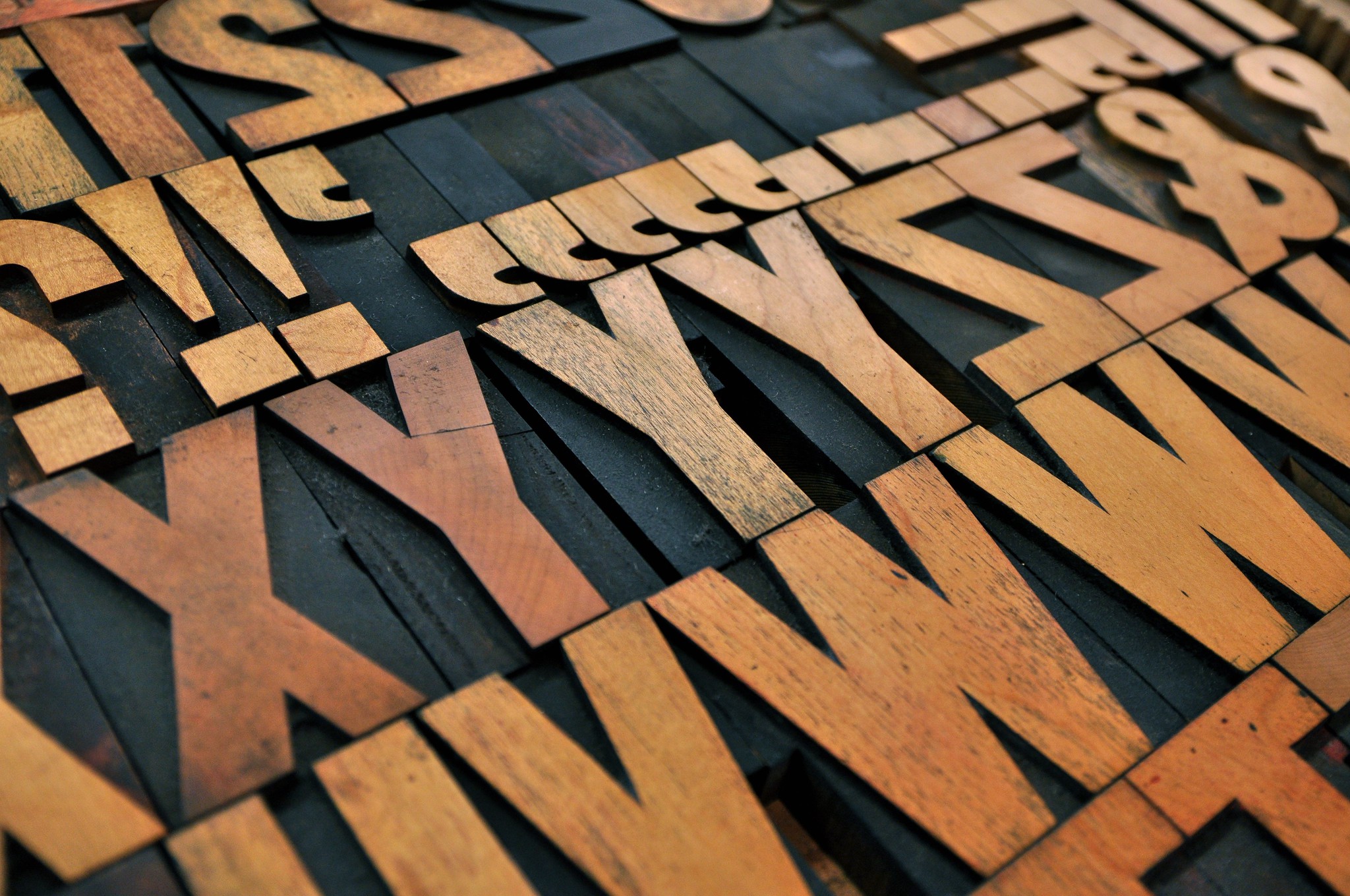
Letterpress printing depends on a raised image, it’s known as a relief process. Movable type was the breakthrough that allowed printers to use and re-use individual characters. When you practice letterpress printing it’s easy to forget just how difficult it must be for type founders to create tiny pieces of cast metal hard enough to withstand a tremendous force that are made to tolerances of less than one thousandth of an inch.
Gutenberg of Germany is credited with the invention of moveable type around 1450; but records show that both Chinese and Korean inventors had used the idea before the time. Gutenberg’s invention was the first to be exploited and the idea spread rapidly. There are three key stages in founding type –
- Punchcutting: creating a three-dimensional representation of the letter in the end of a bar of metal. This skilled work requires a number of other punches and tools to be used to create the punch, and then it be subject to hardening. Modern-day equivalents of punches can be seen in DIY stores to mark metal equipment with initials.
- Creating the Matrix: this step takes the punch, and strikes it in a softer metal to make a negative mould. The metal is usually brass
- Casting: this is filling the mould with molten type metal and removing the cast type
Type Founding in the Printing Economy in the UK
Type founding is a specialist industry needing artistic and design skills in equal measure with engineering prowess and ability to work in some of the very heavy aspects of industry. The industry was centred around the demand in Fleet Street, London; but other significant type founders worked where technical expertise was greatest-for example Stephenson, Blake of Sheffield.
The key constraint for printers was that type from a foundry had to be assembled by hand before printing could begin. This composition activity took a great deal of time and tied up capital in the type needed. As the 19th century grew to a close people we very keen to automate this part of the process-work began to look at producing type in the order it was needed. That’s to say go directly from the copy to the metal type with no sorting or composing process in between.
There became two families of type: foundry type (generally harder quality) that was produced in the great foundries; and composition type (slightly softer quality) that was produced from copy either by a specialist firm, or even by the printer himself.
UK Type Foundries
The UK had a number of very influential foundries. While early metal type from the continent (in particular Dutch type) was considered superior, the UK caught up and great names like Caslon, Figgins and Stephenson, Blake were established. The large number of small foundries gave way to a smaller number of large foundries. The last of the English Foundries, Stephenson, Blake of Sheffield stopped trading in December 2004. That foundry alone had acquired Charles Reed and Sons in 1905, and H. W. Caslon and Co in 1937.
Composition Type
Allowing printers to cast their own type was a key driver behind developments in composition type. There were two broad approaches: build a complete line of type from a machine; or build individual characters in the correct order from the machine.
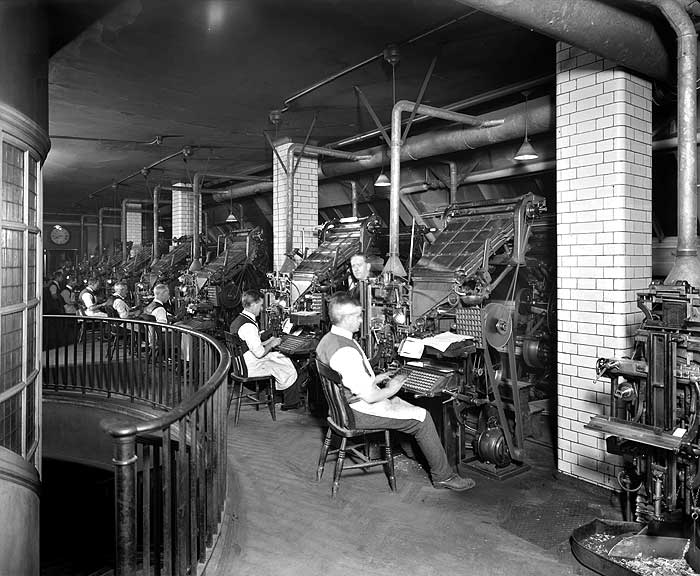
Linotype and Intertype took a similar approach: the operator sat at a keyboard and typed the copy. While copy was being typed the matrices (type moulds) were assembled within the machine. Once a line was completed the moulds were filled with hot type metal and the resulting ‘slug’ was forced from the machine, being trimmed and shaped in the process. The Ludlow Typograph was similar, but the matrices were assembled by hand.
Monotype adopted a different tack. They split the operation between keying the copy and casting the type. Copy was typed on a Monotype Keyboard powered by compressed air which punched holes in a paper tape. The tape was then taken to a casting machine which used the paper tape to position a case of matrices and cast a single piece of type for each keystroke on the paper tape. The advantage of this approach was to allow for correction after composition had been produced by the machine.
In modern times, Monotype machines can be controlled by computer–allowing the direct production of metal type from a computer keyboard.
In this section
-
Choosing Typefaces
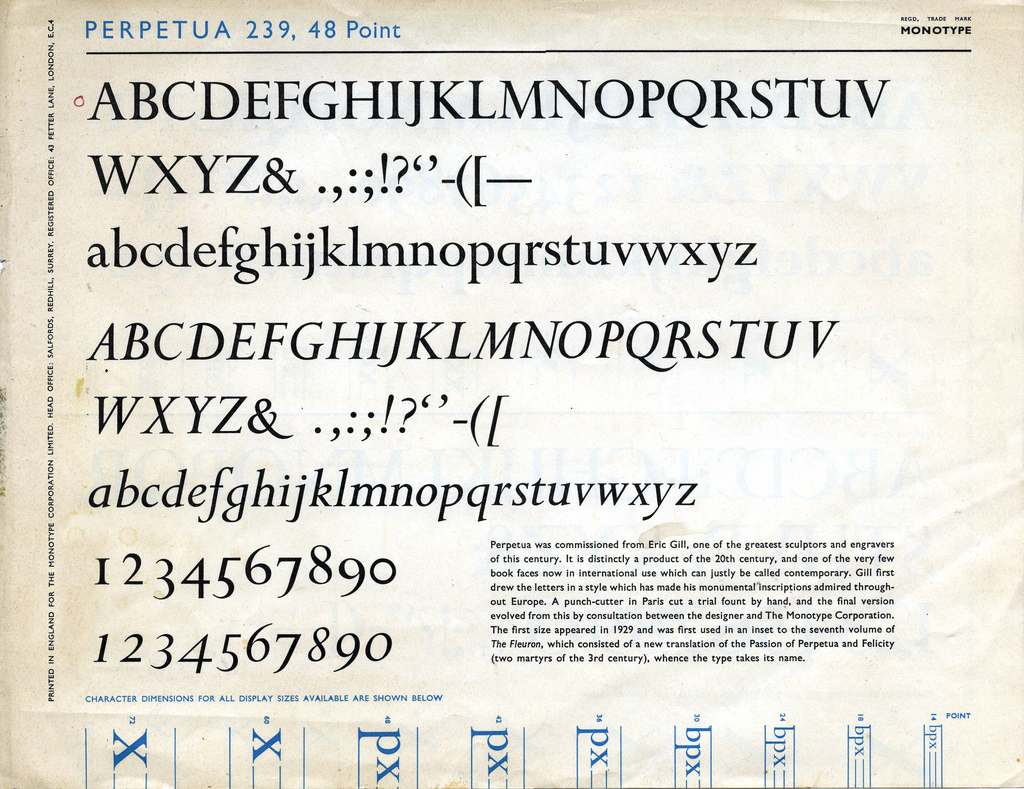
A starting point for the age-old problem of choosing a house face
-

The Point System
How did we in the English-speaking world arrive at 0.01387” as one point?
-

Type Synopses
The obscure join between maths and printing — making sure each letter is in the right proportions
-

Type Founders
Other UK type founders
-
Linotype and Intertype Salvage
A guide — in note form — to salvaging a Intertype or Linotype
-

The Monotype System
The system that spawned a great name in letterpress and the typography we use today
-

The Ludlow Typograph
The less-popular brother of the Intertype/Linotype and the Monotype system
-

Elrod Strip and Rule Caster
The machine used by smaller printers to cast new ‘strip material’
-

Woodletter or Poster Types
Bigger type to produce those wonderful inky letterpress posters
-
Finding Second-Hand Type
How to find and buy second-hand type
Further Information
- Dave Huges’ MetalType.co.uk site focusses on non-foundry type, especially Intertype and Linotype machines. The site also includes some letterpress-related classified adverts