
An account from Hand & Eye of the installation of their latest press.
Tag: London
-

St Bride Library
The St. Bride Foundation is home to the renown St. Bride’s Library, a wonderful collection of letterpress (and general printing) resources.
Ben Weiner from St Bride Library outlines the classes available:
In Autumn 2010 St Bride Foundation began to run regular classes in relief printing techniques at the Foundation building in Bride Lane for the first time since the 1920s.
We launched the new workshop with a range of short courses that teach basic skills and give familiarity with some of the terminology, equipment and activities essential to letterpress work. These courses run in the daytime and during evenings and weekends. Participants get to use some of the presses which form part of St Bride Library’s collection as well as other equipment including an Adana and a Vandercook press.
We plan to cover the kindred trades, especially linocutting and book binding. We also plan a range of more advanced courses that will give participants more scope to create and fulfil their own briefs working with the guidance of an experienced practitioner.
We welcome enquiries about our courses and hope to become a significant contributor to the letterpress printing community. Full details of the workshop are online.
-
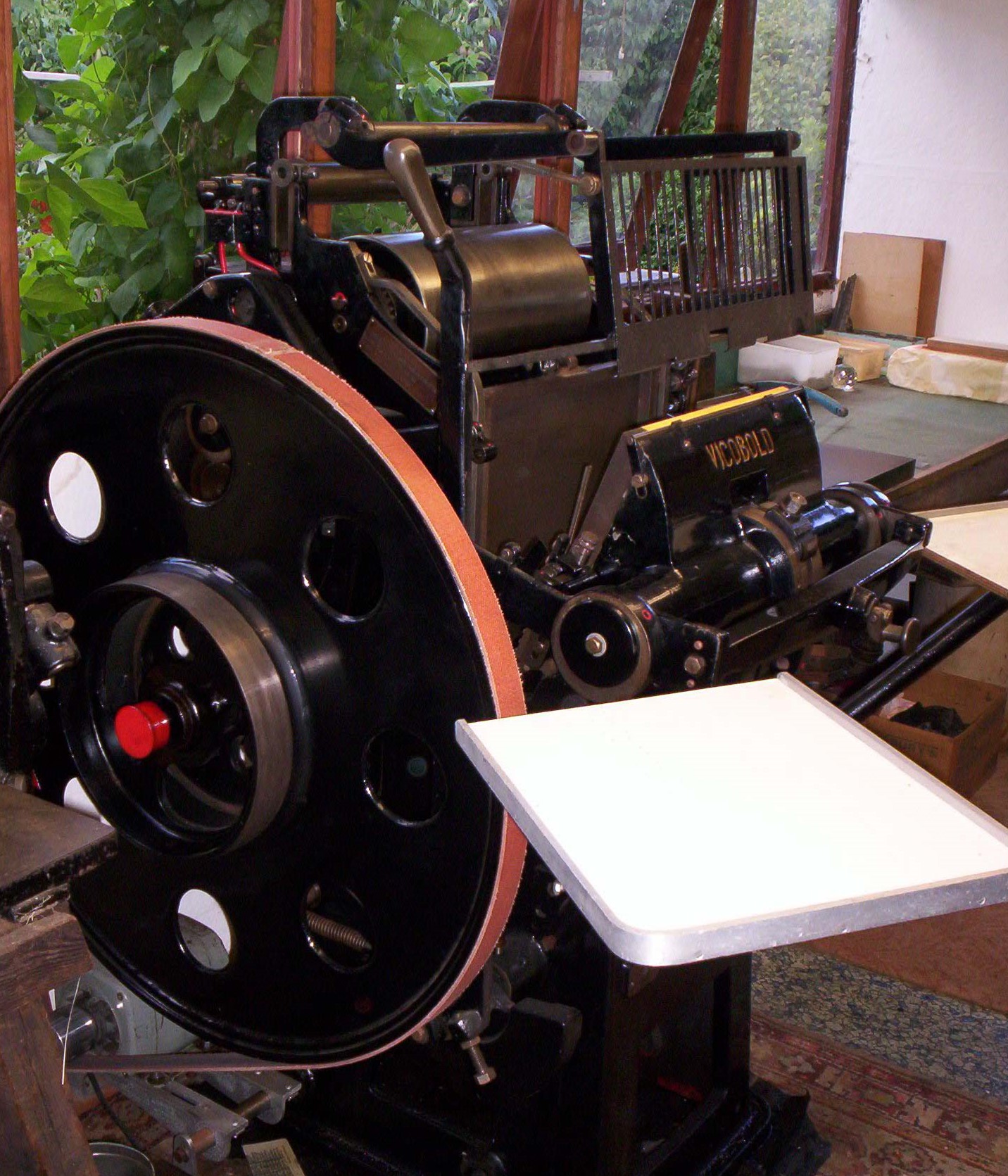
Vicobold Machines: Victoria Platens
These presses are of German descent — made by Rockstroh-Werke AG of Heidenau — but were made in the UK by Frank F Pershke.
Rockstroh-Werke AG made three models of machine -
- Victoria (Model ‘B’)
- Auto-Victoria (Model ‘C’)
- Kobold
The three UK-made models were -
- Vicobold
- Autovicobold
- Autovic
Information from Frank F Pershke adverts is reproduced below. The address given was Dover House, 170 Westminster Bridge Road, London SE1
General Principles
The key feature of these machines is that they employ a ‘parallel platen’ approach. The platens are not hinged (like most other presses), but runs on rails in the vertical position. This ensures that impression is even over the face of the forme.
Inking is by a rotating cylinder at the head of the machine — rather than an inking disk. The machines are based on the Victoria Heavy Art Platen.
Vicobold
Machine Max Sheet Size Inside Chase Size Platen Size Space Occupied Power Required Net Weight Vicobold 10.25″ x 14″ (26 x 35.5cm) 9.5″ x 13.25″ (24 x 33.5cm) 11″ x 14.25″ (28 x 36cm) 49″ x 47″ (124 x 120cm) 0.5hp 8.5cwt (425kg) This machine is hand-fed and follows the same principles as the others in the series. Ink is supplied to the inking drum through a screw controlled duct, and transferred to the forme with two rollers. Impression strength can be changed with a single nut at the back of the platen: the parallel approach takes care of all of the forme with that one change.
There were at least two models — the Model ‘C’ which was motorised; and a Model ‘T’ run with a treadle.
Autovicobold
Machine Max Sheet Size Inside Chase Size Platen Size Space Occupied Power Required Net Weight Autovicobold 10.25″ x 14″ (26 x 35.5cm) 9.5″ x 13.25″ (24 x 33.5cm) 11″ x 14.25″ (28 x 36cm) 38″ x 62″ (97 x 219cm) (with auto feeder in position) 1.5hp 13cwt (650kg) This machine is essentially the Vicobold with an automatic feed and delivery system. A selling feature was that the feed and delivery system could be wheeled away when needed: allowing the machine to be used as a hand-fed machine, and also to allow open access to the working area during set-up.
Autovic
Machine Max Sheet Size Inside Chase Size Platen Size Space Occupied Power Required Net Weight Autovic 13.375″ x 18.125″ (34 x 46cm) 13.5″ x 17.75″ (34.5 x 45cm) 14.25″ x 18.875″ (36 x 48cm) 56″ x 65″ (141 x 165cm) (with auto feeder in position) 1.5hp 24cwt (1220kg) This machine is a larger size than the other two models, and occupies a substantially larger space. It was supplied with an optional feed system. Inking is by means of three rollers: two are in contact with then forme on the way ‘down’, and the third roller is engaged with the form only on the way ‘up’. There are two additional rollers in the inking mechanism for ink distribution. An automatic wash-up system is also included.
-

Model Press
“Everyone his own printer” was the phrase used by many, but claimed by the Model Press people. This small press was never sold just as a toy, or machine for the hobbyist, but was marketed to appeal to the widest audience.
William Clark and Joshua Daughaday patented the design for the Model Press in the USA in 1874. Carlo Giuseppe Squintani took the British patent out on 10 April 1877 — the Model Press had arrived in the UK.
Squintani sold presses from Summer 1877 — but there’s a question over whether those first presses were manufactured in the UK or imported. By 1888 Squintani’s adverts claimed the presses were made by a high-quality engineer in London. Bob Richardson has recently discovered that the engineer was Peter Hooker Ltd in Walthamstow.
To ensure widest appeal the presses were made in a variety of sizes from the No. 0 (with a 2 and one-eighth inch by 3 3/4 inch chase) to the treadle-driven No. 6 Job (with a 9″ x 13″ chase). The American and French numbering system for model presses differed from the UK versions. The table below shows the key sizes.
Model Chase Size (inches) Hand- or Treadle-driven Weight* (lbs) No. 0 2.125 x 3.75 Hand None Given No. 1 3.125 x 5.125 Hand 65 No. 2 5 x 7.5 Hand 112 No. 3 6 x 9 Hand 148 No. 3 High Speed 6 x 9 Treadle None Given No. 4 7 x 10.5 Hand 248 No. 5 Job 7 x 11 Treadle None Given No. 6 Job 9 x 13 Treadle None Given * Weights from John Ryder’s Printing for Pleasure.

Model Treadle Press (from Excelsior Catalogue) W E Cook advertised the ‘Improved Model’ press between 1898 and 1900 in only one size: an 11″ x 5″ treadle platen.
While the Model Press was sold for nearly a hundred years, the appeal of the Adana seemed to eclipse it despite the Model being a more sturdy-built press.
In common with Adana, Squintani sold complete outfits including the press, type and ink from their showrooms in Farringdon, London.
Contributors
Information on this page kindly supplied by Toby Hardwick, Nick Smith and Bob Richardson.