

A rather shorter article here (with a plea below for more information!) but hopefully this adds something to your understanding of printing, and offers some advice.
Using a Composing Stick
From John R Smith’s Technical Notes for Beginners shared in the OGP Newsletter and reproduced with his permission.
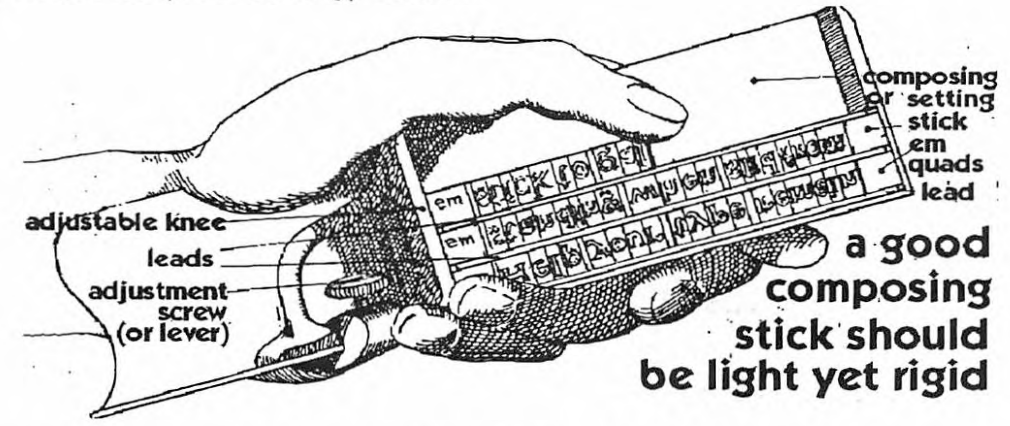
The text-books instruct one to set the composing stick to the measure (column width) and fill it with nothing but type and spaces. For the dexterous Dickensian comp, doing it five days a week, that’s fine. But, beginners invariably find the last few letters per line fall over when transferred to stone or galley. The method I shall outline is less nerve-racking and interline leading generally aids legibility.
Set your stick to the designed measure plus two em quads — (those which are the square of the type-size). Find a set of leads (strips of thin inter-line spacing) each longer than the measure but slightly shorter than measure plus 2ems. Put the first lead in the stick (use a setting rule if you have such rare antiques) then set your first line of type (nick facing away from you and spelling normally). Start and finish with an em quad — or put a wider quad at the end of a short line. Aim to use the middle (mid) size of the spaces between words. Adjust the line with copper or nickel hair-spaces (if you have such luxuries) until it is firm — but not tight enough to strain the stick.
If you don’t have hair-spaces, cut a selection of slivers of varying thickness of paper and card and use those. This will horrify surviving letterpress teachers, but needs must! Place the next lead and an em quad to begin die next line and carry on setting until you have filled the stick with a firm rectangle of type-matter. If you have a set of setting rules, you should now put another in place, tie die whole lot
with page-cord and lift it from stick to galley. I never bother to tie up, preferring lay the stick on the galley and, holding the matter tight, slide it onto the galley where it sits between clumps (large hollow quads) and strips of reglet (thick wood, plastic or metal furniture) until I’m ready to lock it in the chase. This way your type is less likely to fall apart — but I make no pretence of a guarantee!
Compositors and Their Sticks
Rather than equipment of the printing works, composing sticks were the possessions of their compositors that used them.
Though every compositor by Custom is to provide himself a Composing-stick, yet our Master-Printer ought to furnish his House with these Tools also [for apprentices].
Joseph Moxon, Mechanick Exercises on the Whole Art of Printing (1683–4)
Evolution
Sticks evolved — original compositors tools at the Plantin-Mortus museum were reported as sticks crafted to accommodate one of two widths of work — one for the body of the text and another for the marginalia.

At the height of letterpress’ obsession with precision, sticks were created with micrometre adjustment. To aid lockup and the pitfalls of ‘squeeze’ printing houses adopted one of two approaches — either cut leads very slightly short of the measure (typically ¼ of a point), or expand the stick slightly beyond the measure. The effect was the same — when locked up the forme would have a little give, just enough to compress the air, dirt and bent types and so creating a solid block of printing material.

In addition to the usual metal sticks, enormous wooden composing sticks were made for poster types. These delightful contraptions seem always to be patched up, and I can never come to terms with how heavy the stick would have been with, perhaps, 30 inches of woodletter in these.
More Information?
I’ve found a tantalising reference to a 1971 book, Martin K. Speckter’s Disquisition on the Composing Stick. The nearest copy to me is 200 miles away in London, and I wonder whether anyone has a copy they’d be willing to loan so I can add more here about these tools?
Year and Era
Unknown / Craft
Object Type
Other Objects
Location
Tariff Road, Tottenham, as the home of Cefmor-Brehmer Ltd., maker of my favourite composing stick.
Sources and More Information
- John R. Smith’s article
- Moxon, as linked
An Appeal
If you have something linked to this object, please get in touch.
“Movable type on composing stick, The University of Iowa, 1920s” flickr photo by The University of Iowa Libraries https://flickr.com/photos/uiowa/8054875851 shared under a Creative Commons (BY-NC) license