
John Bell
John Bell, born in 1745, was a journalist and newspaper proprietor at a time when these professions were just becoming established. He published many great works, and founded a number of newspapers, including the Morning Post (running until 1937) and The World in 1787.
The World was a newpaper designed to be read, and Bell broke up the layout to aid reading (as copied by the newspaper that became The Times). Bell also dispensed with the ‘long s’ (roman ſ, italic ſ) in The World, and was one of the first to modernise in this way. As an aside, before Bell, the Ames had also dropped the long s in his Typographical Antiquities (1749) and was noted as an eccentric in consequence.
Bell also operated the British Library (not that British Library), which had been established by George Bathoe in the Strand, but then taken over by Bell. This was a lending library financed by subscription.
His son, John Browne Bell, went on to found the News of the World.
Bell’s Types
In Bell’s drive to create attractive types, he wanted to ‘revive and exalt the neglected art of printing in England’. The type engraved by Richard Austin drew on French proportions and ‘modern’ looking faces to give birth to a uniquely English-looking face.
British Letter Foundry
Bell had been a party in Bell and Stephenson’s British Letter Foundry, operating in 1789 at the Savoy. Their specimen book of that year looks to be the first outing of Bell and Austin’s type. By 1793 the foundry was called Simeon Stephenson & Co., and then Simeon and Charles Stephenson which moved from the Savoy to Chancery Lane.
The British Letter Foundry’s specimen book of 1796 says that Richard Austin was cutting punches for them and offered ‘ten pages of large titling letters, fourteen pages of Roman and Italic, from Double Pica to Minion, and the remainder chiefly ornaments’.

Monotype Revival
Bell’s face fell in popularity over the next 144 years. Bruce Rogers, however, decided to resurrect the face for his Riverside Press books. He called this personal revival face Brimmer.
Updike admired these types and traced their history to Stephenson, Blake & Company and sought to create his own casting from their punches. In 1926 the link was made between Brimmer, SB’s punches and Bell/Austin’s work when Updike reviewed a copy of the Address to the World by Mr Bell, British Library, Strand, London.
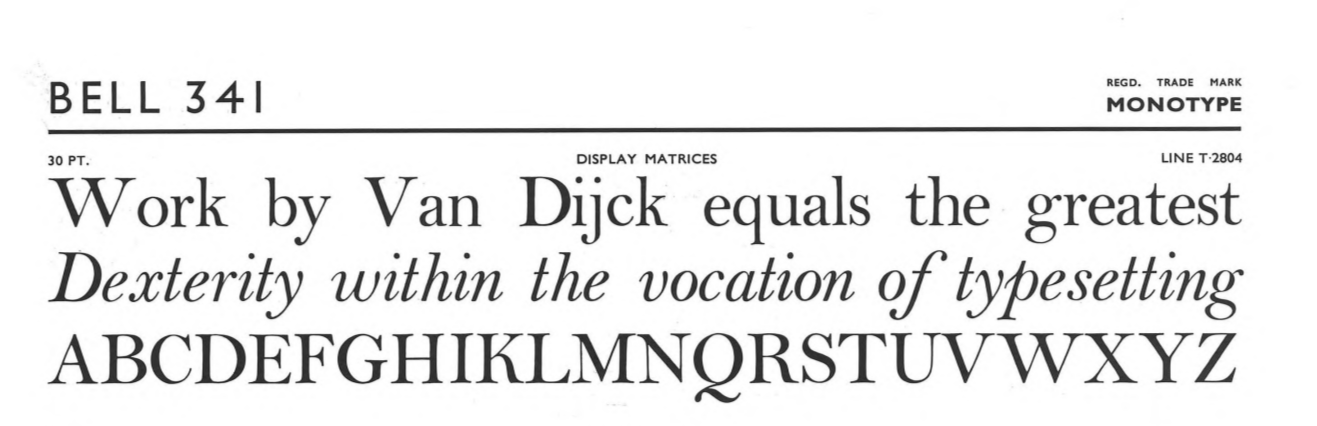
Monotype agreed with Stephenson, Blake for use of the original materials be created their Monotype Series 341: Bell in 1931–2.
Uses
Bell has a very familiar look, but is distinct from other faces. It’s narrower than Baskerville, large on the body and with a stress that’s mainly, but not always, vertical. The face has never had non-lining numerals.
Monotype suggested the face was well suited to most inking and surfaces — not something that could be said for all Monotype faces.

Year and Era
1789 / Commercial
Object Type
Types and Casting
Location
Address of Bell & Stephenson’s Foundry, ‘in the Savoy’ — essentially close to his ‘British Library’ in near Exeter Exchange, Strand, London
Sources and More Information
- Monotype Specimen Sheet
- Monotype Recorder Vol 32
- Talbot Baines Reed, A History of the Old English Letter Foundries
- Steinberg, S. H., Five Hundred Years of Printing
An Appeal
If you have something linked to this object, please get in touch.
Header Image: Monotype Bell Specimen