Tag: featured

  • Squeeze

    Squeeze

    The word ​‘squeeze’ sounds like one of those pass­words that are used by the print­ing world sim­ply to add to the mys­tique of let­ter­press.  It’s true that it has been used in the past by some print­ers to jus­ti­fy some very impre­cise prac­tices.  That said, squeeze is some­thing for print­ers to think about, espe­cial­ly those con­cerned with pre­ci­sion.

    After World War II the gen­er­al dri­ve for greater pro­duc­tiv­i­ty and qual­i­ty meant print­ers need­ed to adopt ever more pre­cise ways of work­ing to avoid prob­lems dur­ing print­ing and also increase the pro­duc­tive hours of each machine.  Where once objects like fur­ni­ture and blocks could be points adrift from their stat­ed size, they now had to be cor­rect.

    ‘Squeeze’ is the term to describe the dif­fer­ence between the length of a line of type as sat in the com­pos­ing stick; and the same line when locked up in a chase ready to print.  The accept­ed view was that a com­pos­i­tor should set type a lit­tle longer than the mea­sure (line length) but the forces of quoins would squeeze the type togeth­er and bring it back to the intend­ed size.

    Know­ing that type met­al itself can­not usu­al­ly be com­pressed, we have to look at what else could cause this phe­nom­e­na –

    • Dirt and oth­er deposits on the walls of type might be com­press­ible
    • Bent spaces might be brought back in to true
    • Type that is not straight in the stick (‘off its feet’) may be cor­rect­ed to an upright posi­tion
    • Basic equip­ment, like the com­pos­ing stick, might be inac­cu­rate

    It fol­lows, then, that if clean new type is used in an accu­rate­ly made and set com­pos­ing stick and the line is prop­er­ly jus­ti­fied then there is no room at all for com­pres­sion and so squeeze is elim­i­nat­ed.  Remem­ber that the pres­sure of the quoins on the spe­cif­ic lines will be around the same as the pres­sure of the com­pos­ing stick ends.

    The prob­lem then becomes ​‘how can the line be accu­rate­ly filled’, for the end­less com­bi­na­tions of char­ac­ter widths and stan­dard spaces will always leave some room at the end of a line.  As an exam­ple, a line of 14pt type is set and a gap at the end of the line is too small to be filled with a thick space, and too big to be filled with a mid­dle space.  The dif­fer­ence between the two is 1 and 1/6 of one point.

    Nat­u­ral­ly spaces can­not be made in each pos­si­ble size, so if we are using the pre­ci­sion approach above every line will be short because an irreg­u­lar space will exist at the end of each line.  Our answer now is to make sure that, on aver­age, each line is cor­rect.

    To do this we have to estab­lish a com­mon space: what is the aver­age dif­fer­ence between any two stan­dard sizes of space.  Just how big is the jump between mid and thick; or thin to mid; or mid + thin to nut?

    Sav­ing you the maths, the answer is 7/120ths of an em, and con­vert­ing this to points the aver­age is 7/12th of a point.  That is to say that any giv­en com­bi­na­tion of type and stan­dard spac­ing will be between 7/24th over line length and 7/24th under line length.  We have to fur­ther round this to a usable unit, and the key point is to set your com­pos­ing stick to ½pt over the desired line length.

    To make the best of this, the fol­low­ing points should be observed –

    • Com­pos­ing sticks should be peri­od­i­cal­ly checked for accu­ra­cy
    • Pre­ci­sion, milled, em gauges should be used to set the stick along with a half-point gauge.  All sticks should be set from the same gauges
    • When using type over 14pt, use half-point ​‘hair’ spaces
    • Leads should be cut to the line length minus one point
    • Reglet should be used down the sides to pages to take any remain­ing irreg­u­lar­i­ty in jus­ti­fi­ca­tion

    None of these prin­ci­ples apply to Mono­type mat­ter (unless being cor­rect­ed) or Lud­low or Intertype/Linotype slugs as these are cast to pre-defined lengths exact­ly.

  • Letterpress From Scratch

    Letterpress From Scratch

    The let­ter­press print­ing process is one of the old­est ways of get­ting the print­ed word on to a page. It relies on a phys­i­cal rep­re­sen­ta­tion of each let­ter being inked and then pressed against the paper — and this is why it’s both inter­est­ing and expen­sive. Think­ing a lit­tle fur­ther about it for each page the print­er needs a piece of met­al to rep­re­sent every sin­gle char­ac­ter; a way of apply­ing ink to each char­ac­ter and a machine to force the met­al and paper togeth­er. It fol­lows that chang­ing from bold to ital­ic, for exam­ple, will need a total­ly new set of met­al char­ac­ters rather than a few clicks of a mouse. Oth­er print­ing process­es like lith­o­g­ra­phy or dig­i­tal print­ing are more flex­i­ble, quick and less expen­sive. But while com­mer­cial let­ter­press is in decline there are many who are start­ing from scratch with this won­der­ful process.

    This arti­cle looks briefly at this resur­gence of inter­est in let­ter­press, why you might like it and some help to begin enjoy­ing this fas­ci­nat­ing pas­time.

    So why do peo­ple want to get into this arcane world? The biggest rea­son I can find is that it offers a hands-on imme­di­a­cy that oth­er meth­ods can’t offer. The whole process feeds the sens­es: the cold­ness and weight of met­al type; the rhythm of print­ing machines cycling qui­et­ly; the smell of oil and ink and the great sense of see­ing a won­der­ful print­ed page. Our grow­ing demand for the ​‘one-off’ or the home-grown trans­lates to let­ter­press where each item has been han­dled, pre­pared and checked indi­vid­u­al­ly.

    It’s a con­strain­ing process but allows a cer­tain free­dom which inspires lots of design­ers. The time tak­en can induce a con­cen­tra­tion which excludes the imme­di­ate world. In many ways let­ter­press is the antithe­sis of the mod­ern graph­ics work. It pro­vides a won­der­ful and absorb­ing pas­time that demands just as much time, space and mon­ey as you would like to allow.

    Let’s look now at how you can get into this world. First, you should estab­lish a pur­pose for your ven­ture. Some peo­ple come to let­ter­press to make mon­ey. I’ll be frank and say that you’ll need to be very good, have plen­ty of time and effort to be able to make a prof­it — try to begin with a ​‘plea­sure as prof­it’ approach to test the waters first. Many of us have a mild obses­sion with typog­ra­phy and let­ter­press is a won­der­ful way of being immersed in the detail of type and design. Com­mon terms in dig­i­tal design: points and picas, lead­ing and white space all appear as three-dimen­sion­al objects bring­ing a new clar­i­ty to your think­ing about the print­ed page.

    You might want to devel­op new skills. I’ve espe­cial­ly enjoyed the engi­neer­ing side of let­ter­press: tak­ing old and dirty machines, clean­ing them, mak­ing small repairs and get­ting them run­ning again. There’s a min­i­mal out­lay in terms of tools and the equip­ment is so well made that it with­stands the efforts of the ama­teur.

    Armed with a pur­pose, you need to speak to some­one about let­ter­press. There are many won­der­ful online com­mu­ni­ties out there cater­ing for the let­ter­press new­bie, but most of the expe­ri­ence rests with the job­bing print­er on your high street who still isn’t on the infor­ma­tion super­high­way. Many print­ers are keen to help new let­ter­press print­ers and you can’t afford to miss out this step — ​‘word of mouth’ is still the biggest source of infor­ma­tion in the let­ter­press world. If you have no luck local­ly (and the decline in com­mer­cial let­ter­press might mean you might meet blank faces) then you’ll have to con­tact a ‘fine book’ or ​‘pri­vate press’ print­er and they too will help new print­ers when they can.

    Once you have found some­one, you can ask some of the more detailed let­ter­press ques­tions: how did you start print­ing? is there any equip­ment avail­able local­ly? where would I get the ​‘con­sum­ables’ like ink and paper? You need also to ask about get­ting some hands-on expe­ri­ence. Are there any local class­es, enthu­si­as­tic print­ers or pro­fes­sion­al print­ers who would be will­ing to give you some time with them? Take some time to get into let­ter­press as much as you can while you exper­i­ment with this as a hob­by.

    You’ll now have a much bet­ter feel for whether let­ter­press is for you. Let’s take stock for a moment about what lies ahead — you need to decide how much time, space and mon­ey you can afford to invest in let­ter­press. There are plen­ty of guides that can take you from here: decid­ing on a par­tic­u­lar machine, the act of print­ing and devel­op­ing a style. One key point: you can get the ben­e­fits of let­ter­press from the most mod­est of equip­ment — there is no need to put off print­ing through lack of space or mon­ey — start small.

    On now to some top tips for your next steps –

    • Remem­ber that there’s a lan­guage bar­ri­er. Just as web design­ers wince when novices talk of using tables for lay­out; print­ers share their own lan­guage with its own nuances — the point and picas, lead­ing, formes and founts are all spe­cial­ist terms. Give your let­ter­press guide a sense of your enthu­si­asm by using the right terms
    • Set some para­me­ters for your­self. It’s easy to acquire all man­ner of things and you’ll very quick­ly run out of space. Work out what you need to get hold of and where it will go when it’s home. In terms of finances cheap press­es can soon esca­late in cost when rig­ging and mov­ing is includ­ed
    • Soak up the let­ter­press resources on the web
    • Steal­ing John Ryder’s words, see ​‘plea­sure as prof­it’ and enjoy your new hob­by before tak­ing on pay­ing work

    Offline help

    There are many books about let­ter­press, but few start from the posi­tion of the ama­teur tak­ing their first steps. I’d rec­om­mend John Ryder’s Print­ing for Plea­sure and J. Ben Leiber­man’s Print­ing as a Hob­by but unfor­tu­nate­ly these are out of print — try look­ing for sec­ond-hand copies of them. For prac­ti­cal help Gen­er­al Print­ing (re-print­ed by Liber Aper­tus Press) gives an excel­lent illus­trat­ed guide to each step in the process.

  • The Ludlow Typograph

    The Ludlow Typograph

    The Lud­low Typo­graph — more com­monly ​‘the Lud­low’ — is a machine that com­bines hand assem­bly of each char­ac­ter, along with the cast­ing of brand-new type for each line.  The oth­er type found­ing machines used by print­ers were dri­ven by a key­board: the Linotype/Intertype machines hav­ing the key­board built-in; and the Mono­type using a key­board to punch paper tape.

    The prin­ciples behind the Lud­low are sim­ple — the oper­ator col­lects a small brass mould for each char­ac­ter need­ed in the line.  These are assem­bled into a ​‘stick’, a small frame, and the moulds are clamped togeth­er to form a line of moulds.  This stick and moulds are then clamped in to a machine which injects hot met­al into the moulds.  A line of type is cast and ejec­ted from the front of the machine.  The moulds have to be dis­trib­uted back into the rel­ev­ant cas­es by hand.

    Unusu­ally, the Lud­low can cast between 6pt and 228pt type on slugs with­out changes to the machine.  Oth­er sys­tems have to be mod­i­fied with each size change.

    The Lud­low was typ­ic­ally used in two spheres: the news­pa­per and the rub­ber stamp indus­try.  News­pa­pers typ­ic­ally used the Lud­low to pro­duce head­lines to sit with their Inter­type or Lino­type mat­ter.  Rub­ber stamp mak­ers use the machines to pro­duce the ori­gin­als for stamps.

    Model M

    https://www.youtube.com/watch?v=BWUKy7bpAEA&ab_channel=HarryHarrison
    Har­ry Har­ri­son has shared this pro­mo­tion­al video, like­ly from his fam­i­ly con­nec­tion to the Lud­low com­pa­ny. Thanks Har­ry!
  • Heidelberg Cylinder Presses

    Heidelberg Cylinder Presses

    The fun­da­mental advant­age of a cyl­in­der press is that the impres­sion of paper on type only has to be deliv­ered in a small strip — the point where the cyl­in­der touch­es paper and type.  Oth­er press­es have to get an impres­sion across the whole area of the type at once.  This means cyl­in­der press­es can use a greater force with greater pre­ci­sion that their plat­en equiv­a­lent.

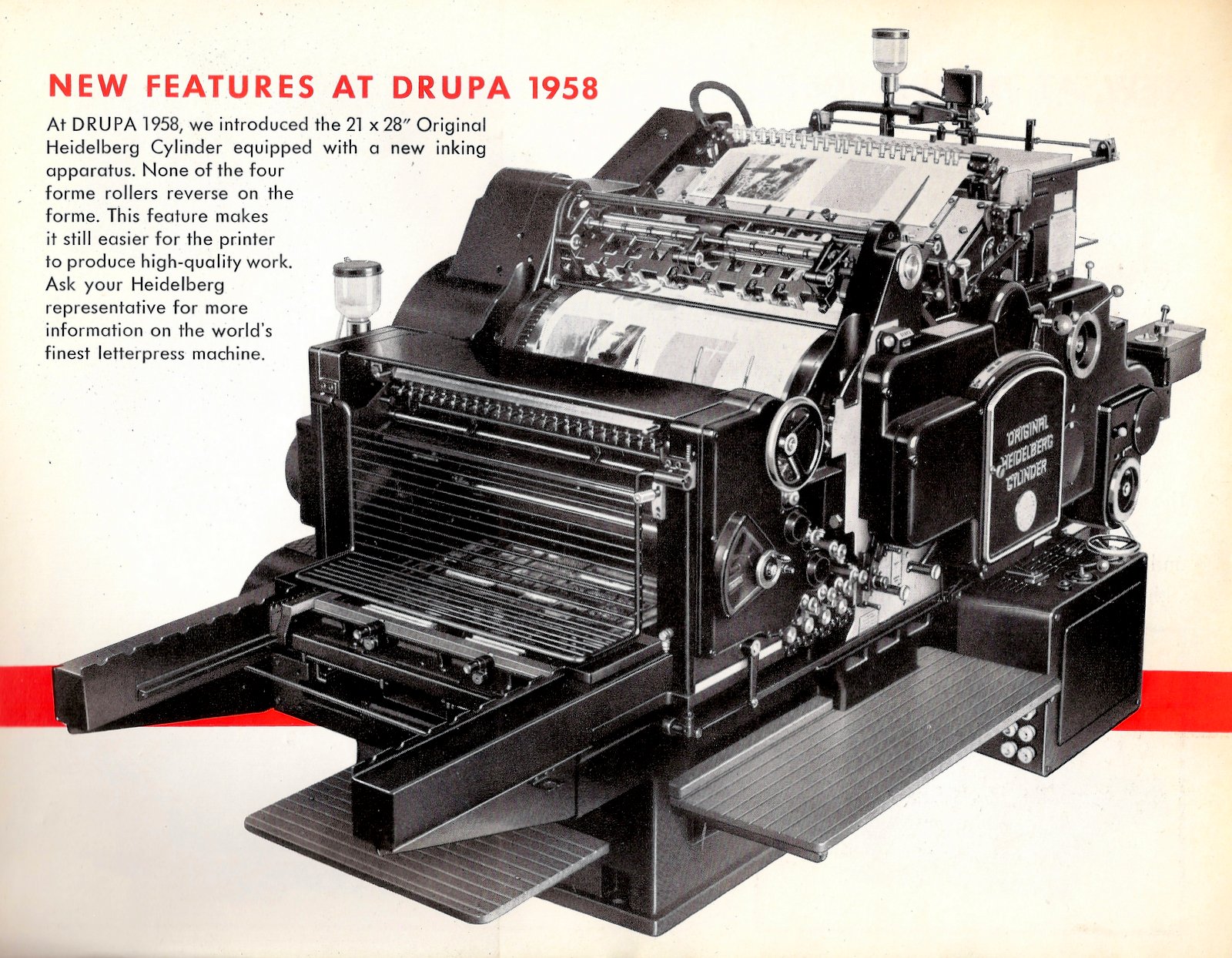
    Heidel­berg cyl­in­der press­es are claimed by many to be the peak of pre­ci­sion let­ter­press work at vol­ume.  Their 1958 offer­ings are detailed below in spe­cific­a­tion and pic­tures from brochures.

    Heidel­berg Cyl­in­der Specifications

    Ori­ginal Heidel­berg Cyl­in­der 15″ x 20½” Ori­ginal Heidel­berg Cyl­in­der 21″ x 28″
    Largest Paper Size 15″ x 20½” 21.25″ x 28.375″
    Smal­lest Paper Size 4.125″ x 5.875″ 4.5″ x 6.375″
    Inside Chase 14.25″ x 18.75″ 20.25″ x 26.375″
    Max­imum Run­ning Speed 5,000 iph 4,000 iph
    Floor Space Required 8’4.5″ x 4’7.125″ 11’2.25″ x 6’3″
    Pow­er Required 5.5 hp 7 hp
    Net weight 7,950 lbs (gross) 13,650 lbs (gross)

    Ori­ginal Heidel­berg Cyl­in­der 15″ x 20½”

    Hei­del­berg Cylin­der 15 x 20

    Ori­ginal Heidel­berg Cyl­in­der 21″ x 28″

    Hei­del­berg Cylin­der 21 x 28
  • Disposing or Selling Letterpress Equipment

    Disposing or Selling Letterpress Equipment

    You might have vis­ited this site look­ing for help to get rid of let­ter­press equip­ment. You’ll find that there are peo­ple always start­ing let­ter­press and so a steady stream of poten­tial recip­i­ents for what you have. If you encounter a par­tic­u­lar prob­lem, or would like more spe­cific help in dis­pos­ing of type and equip­ment, feel free to con­tact me

    Tak­ing Stock

    The first step is to estab­lish what you have. You might have a press, type and some oth­er bits and pieces. It would be wise to make a note of every­thing and decide what you want to keep, what you want to pass on what you want to throw away.  Print­ers will always want to know what’s on the front of your type cas­es.

    A Strategy

    You’ll need to decide how you will dis­pose and what you want from it. On the ques­tion of ​‘how’, you need to decide whether to dis­pose in one lump — get rid of every­thing at once — or if you can afford the time and space to allow peo­ple to be selec­tive.

    The biggest ques­tion is ​‘what do I want from this?, and this falls in to some groups –

    • I want to make mon­ey: you should look to list your equip­ment on the web, on a site like eBay or Bri­ar­Press. This will attract the biggest audi­ence and dri­ve prices up
    • I want it to be used by some­one start­ing let­ter­press: I’d sug­gest con­tact­ing one of the organ­isa­tions allied to print­ing and its pre­ser­va­tion to get the word-of-mouth con­tacts
    • I want it to be pre­served: unfor­tu­nat­ley print­ing equip­ment is not a fash­ion­able arte­fact for many muse­ums and few will accept it. Start with your local Council’s muse­um ser­vice

    Execut­ing the Strategy

    Regard­less of the path you take, there are key things any­one will want to know about what you have –

    • What’s includ­ed?
    • How much room does it take up?
    • If type is avail­able, the faces and sizes (nor­mally shown on the front of the type case)
    • How access­ible the things are (is it in a damp shed at the end of a dirt track; or in an awk­ward door­way?)
    • If a press is involved be pre­pared to give an estim­ate of weight and the con­di­tion of the rollers